

The Complete Commercial Kitchen Maintenance Checklist by Frequency
Daily Maintenance Checklist
Refrigeration and Cold Storage Daily Checks
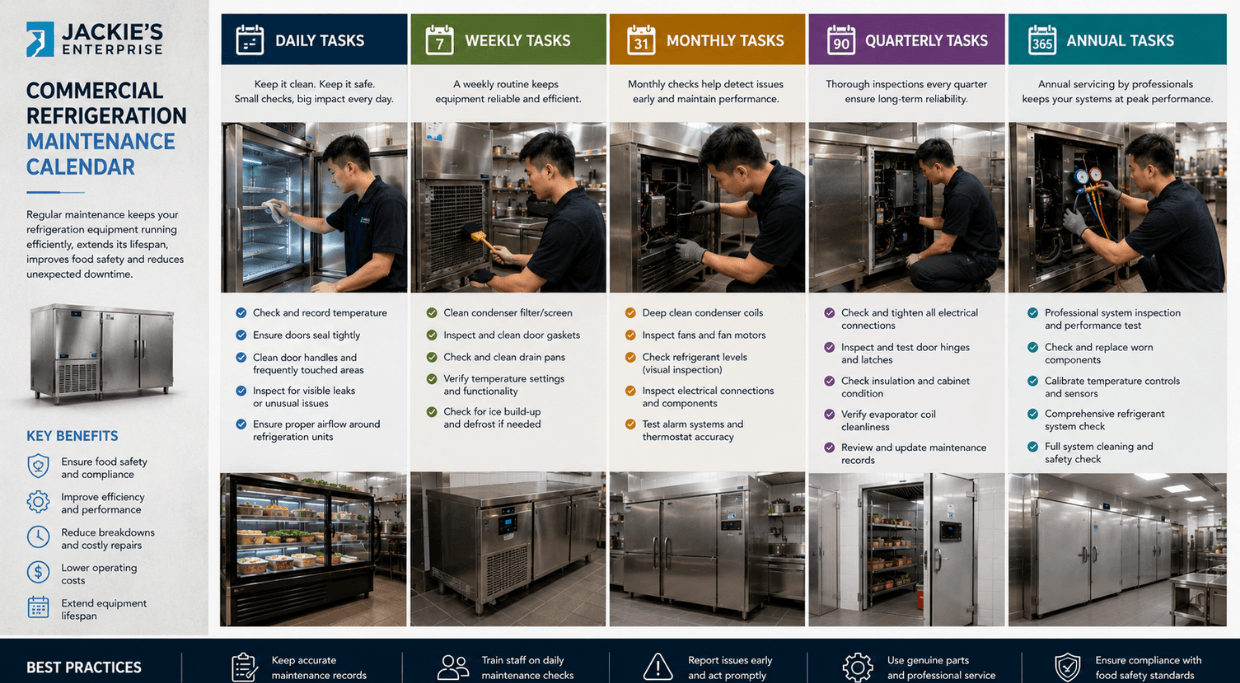
Temperature logging is the single most important daily task. Record the actual temperature of every refrigeration unit at the start and end of service using a calibrated thermometer, not the thermostat dial. Inspect door gaskets for tears or compression failure. Check for unusual compressor noise or ice build-up on interior coils. Confirm the internal drain tray is clear.
Cooking Equipment Daily Cleaning and Checks
Confirm all burners light correctly with a normal blue flame. Check fryer oil for excessive darkening, smoke at normal operating temperature, or foam, all of which indicate degradation and increasing fire risk. Inspect oven door seals for integrity. Check griddle surfaces for warping or uneven heat.
Surface, Floor, and Drain Daily Cleaning
Clean and sanitise stainless steel work surfaces after service. Sanitisation is a separate step from cleaning and must not be skipped. Inspect floor surfaces for cracks at grout lines and wall-floor junctions. Remove and clean drain covers and flush drain channels.
Grease Filter Daily Inspection
Baffle filter saturation is the most commonly overlooked daily task in Singapore commercial kitchens. Inspect filters for saturation and clean on a schedule appropriate to cooking volume and type. High-volume frying requires more frequent cleaning than light café cooking. Saturated filters reduce exhaust airflow and accelerate grease deposit in ductwork above, creating both NEA and fire compliance exposure.
Weekly Maintenance Checklist
Deep Clean Cooking Surfaces and Burner Components
Remove burner caps and rings and clear blocked ports; blocked ports create incomplete combustion. Deep clean oven interiors and rack guides. Perform fryer boil-out: drain oil, clean the tank with a degreaser, rinse thoroughly, and refill with fresh oil. The boil-out removes polymerised residue that accelerates new oil degradation.
Refrigerator Door Gasket and Temperature Log Review
Close a thin piece of paper in the refrigerator door. If it pulls out without resistance, the gasket is no longer sealing and must be replaced. Review all seven days of temperature logs. A trend approaching the threshold without yet breaching it is an early indicator of condenser fouling or refrigerant loss.
Floor Drain Deep Cleaning and Pest Entry Point Inspection
Flush drain channels with a degreasing product and hot water. Inspect gaps around pipe penetrations through walls and floors, confirm drain screens are intact, and check the perimeter for new gaps at the wall-floor junction.
Exhaust Canopy Interior Weekly Inspection
Look into the canopy plenum above the baffle filters for visible grease on interior walls and the duct entrance. Grease that has progressed to the duct entrance means the next quarterly professional cleaning must be scheduled earlier than planned.
Monthly Maintenance Checklist
Commercial Refrigerator Condenser Coil Check
Locate the condenser coil on top-mount or bottom-mount units and brush or vacuum the fins monthly with a soft brush. A fouled coil forces the compressor to work harder, increases energy consumption, reduces the unit’s capacity to maintain low temperatures under load, and shortens compressor life.
Cooking Equipment Calibration and Performance Check
Set the oven to a specific temperature and verify with an independent probe thermometer. A 10°C or greater discrepancy indicates thermostat drift requiring professional calibration. Perform the same check on fryers; thermostat drift creates both food quality and fire risk.
Grease Trap Inspection and Pumping Schedule Review
Open the grease trap and measure the accumulated grease layer depth. A layer exceeding one-quarter of the trap’s liquid depth indicates the current pumping schedule needs to increase. Check for overflow evidence or odour indicating a downstream blockage.
Fire Suppression System Visual Check
Confirm the manual pull station is accessible, nozzles over cooking equipment are unobstructed, and the pressure gauge is in the green zone. Monthly visual checks do not replace the annual professional inspection required under SCDF regulations.
Quarterly Maintenance Checklist (Professional Service Required)
Exhaust Hood and Ductwork Professional Cleaning
A licensed contractor cleans the canopy interior, filter housings, ductwork, and rooftop exhaust fan. The cleaning certificate produced is the primary evidence of NEA compliance. Check the report for confirmation that cleaning reached all accessible ductwork sections.
Commercial Refrigeration Professional Service
A quarterly professional service covers five tasks. First, a refrigerant level check by a licensed refrigeration technician (required under Singapore’s environmental regulations). Second, evaporator and condenser coil inspection and cleaning. Third, door gasket replacement where needed. Fourth, thermostat calibration. Fifth, a written service report documenting all findings.
Grease Trap Professional Cleaning and Pumping
A licensed waste contractor pumps out accumulated grease and solids, cleans the trap interior, and issues a pumping record for NEA compliance. The pumping frequency is informed by monthly inspection data; if monthly checks show rapid accumulation, quarterly may be insufficient.
Annual Maintenance Checklist (Licensed Contractor Required)
Full Kitchen Ventilation System Inspection and Report
Annual inspection covers structural integrity of the canopy, ductwork joints and seals, exhaust fan motor and bearing condition, and airflow balancing. The report is worth retaining indefinitely as a baseline and demonstration of regulatory diligence.
Electrical Safety Inspection of All Commercial Equipment
Under Singapore’s Electricity Act, electrical installations above a certain rating require periodic inspection by a Licensed Electrical Worker (LEW). The inspection covers earth bonding, cable condition, connection integrity, and the condition of commercial-grade sockets and isolator switches.
Pest Control Professional Annual Treatment
SFA’s food hygiene licensing conditions require evidence of active pest prevention. Professional annual treatment addresses harborage points, entry point sealing, and baiting that goes beyond routine kitchen team monitoring. Treatment records are the primary compliance evidence.
Full Equipment Service and Documentation for SFA Renewal
At licence renewal, SFA may request evidence of a functioning FSMS. The annual service record set, covering daily temperature logs, quarterly certificates, grease trap pumping records, pest control records, and corrective actions taken, constitutes that evidence.
Who Does What: Staff Tasks vs Licensed Professional Requirements

What Kitchen Staff Can Perform Without a Contractor
All daily checklist items, weekly cleaning and visual inspections, monthly condenser coil brush cleaning, monthly calibration checks, and monthly grease trap measurements are staff-performable tasks. Kitchen staff also perform the critical early detection function: they see the equipment every day and are best positioned to notice performance changes before they become failures.
What Must Be Done by a Licensed or Registered Contractor in Singapore
Task | Frequency | Required Contractor Type |
Exhaust hood and ductwork cleaning | Quarterly | Licensed environmental / NEA-registered contractor |
Refrigerant level check and top-up | Quarterly | Licensed refrigeration technician |
Grease trap pumping | Quarterly | Licensed waste contractor |
Full ventilation inspection | Annual | Specialist ventilation contractor |
Electrical safety inspection | Annual | Licensed Electrical Worker (LEW) |
Fire suppression system service | Annual | SCDF-registered contractor |
Pest control treatment | Annual | Licensed pest control operator |
Using an unlicensed contractor transfers liability to the food business operator. If an unlicensed contractor performs a task that results in a failure or incident, the licensed operator bears the consequences.
How to Identify and Engage the Correct Contractor Type for Each Task
Verify contractor licensing before engaging: NEA maintains registered contractor lists for environmental services, and the Energy Market Authority (EMA) maintains the register of Licensed Electrical Workers at ema.gov.sg. Request a current licence copy, insurance certificate, and sample maintenance report before confirming any engagement. A fixed roster of approved contractors for regular tasks reduces scheduling overhead and ensures consistent documentation format.
How to Document Maintenance for SFA Audits
What SFA Inspectors Look for in Maintenance Records
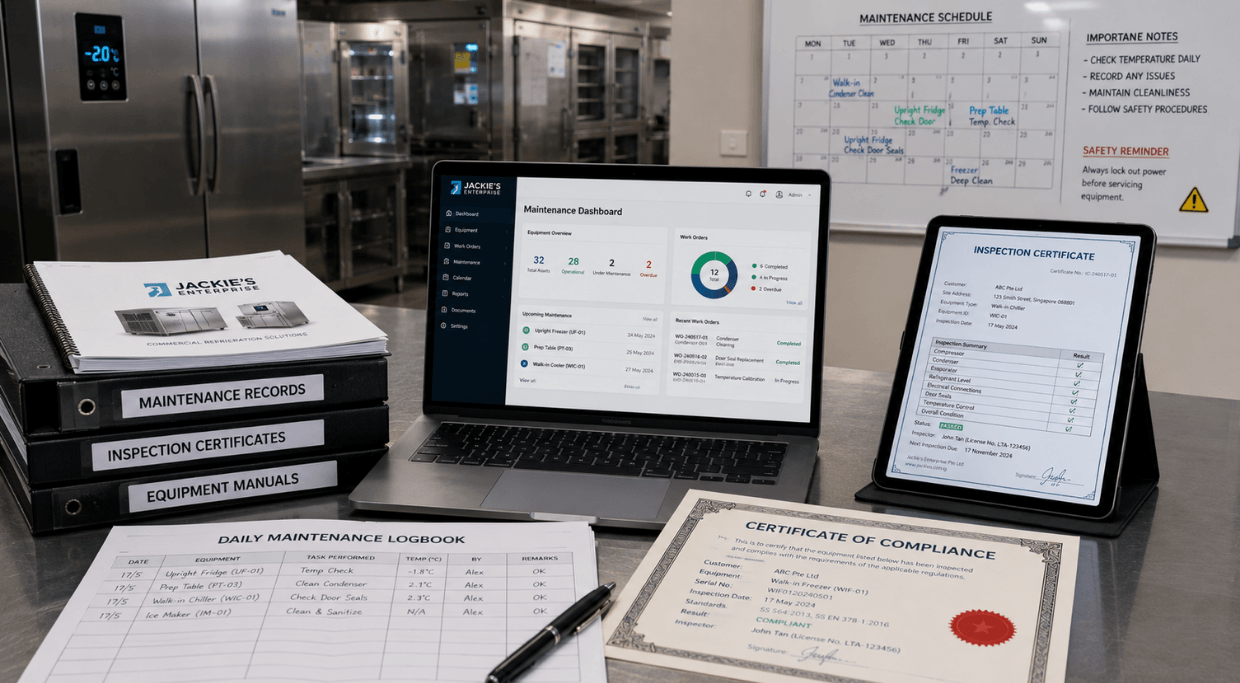
Five elements satisfy inspectors: the date, the task description, the person responsible, the finding or outcome, and any corrective action with its completion date. A record showing “no issues found” is as valuable as one showing a defect was identified and corrected. It demonstrates the inspection was performed, not just that problems were resolved.
The Simple Record-Keeping System That Satisfies FSMS Documentation Requirements
A bound logbook with dated daily and weekly entries, a digital folder for quarterly and annual contractor certificates, and a monthly summary sheet confirming all scheduled tasks were completed satisfies most FSMS documentation requirements. Digital records are increasingly accepted by SFA; they are legible, date-stamped, and retrievable without the risk of a physical logbook being lost.
How Jackie’s Enterprise and Similar Singapore Commercial Kitchen Equipment Suppliers Support Operators With Maintenance Scheduling for Their Equipment
Jackie’s Enterprise is one example of a Singapore commercial kitchen equipment supplier that provides maintenance scheduling guidance for the equipment it supplies, helping operators understand the specific service intervals and licensed contractor types required for each piece of commercial kitchen equipment.
Conclusion
Commercial kitchen maintenance in Singapore is embedded simultaneously in SFA licensing conditions, NEA environmental requirements, and SCDF fire safety obligations. The five frequency tiers cover everything: daily temperature logging and equipment checks, weekly deep cleaning and performance reviews, monthly condenser coil cleaning and calibration, quarterly professional hood cleaning and refrigeration service, and annual ventilation inspection, electrical safety inspection, and pest control treatment. Daily through monthly tasks are staff responsibilities. Quarterly and annual tasks require licensed contractors whose documentation serves as the compliance evidence. The programme that is not documented does not exist from an audit perspective. A consistently maintained record set, however simple, is worth more than an informal but thorough routine that leaves no paper trail.