
Can You Really Get Government Funding for Kitchen Equipment?
When F&B operators hear “government grant,” the assumption is usually software: point-of-sale systems, accounting tools, HR platforms. Fewer realise that a commercial oven, a planetary mixer or a blast freezer can also be co-funded under the same scheme.
As a PSG grant, commercial kitchen equipment in Singapore is also supported, provided the equipment is on the official supportable solutions list, and the applicant meets the scheme’s eligibility conditions. Not every combi oven or mixer on the market qualifies, and the order in which you make a purchase can determine whether a claim is ever paid out.
This guide covers who qualifies for PSG, which kitchen equipment categories are typically claimable, how much the grant covers, and how the application process works from vendor selection through disbursement. It also flags a timing issue affecting every F&B operator weighing PSG right now: the scheme closes to new applications within weeks, and that deadline shapes whether you proceed.
Who Qualifies for PSG Support
Before evaluating specific ovens or freezers, confirm whether the business qualifies at all. Eligibility is assessed at the point of application and must continue to hold until the claim is disbursed.
Business Registration and Local Shareholding Requirements
To apply, a business must be registered or incorporated in Singapore, including private limited companies, sole proprietorships, partnerships and limited liability partnerships. Enterprise Singapore also requires a minimum of 30% local shareholding, traced through to the ultimate individual shareholders. These conditions must hold continuously: a change in local shareholding after approval can affect whether a claim is still supported at the claims stage.
SME Size Criteria
The applicant’s group annual sales turnover must not exceed S$100 million, or its group employment size must not exceed 200 workers; only one threshold needs to be met. Because the criteria apply at group level, a kitchen within a larger F&B group should check the group-wide figures, not just the outlet’s own turnover.
The Pre-Approved Vendor and Solution Requirement
This is where most confusion sets in. For IT solutions, PSG only supports pre-scoped packages purchased from pre-approved vendors: an unlisted solution or unapproved vendor is not supported, however similar it looks to an approved one.
Equipment works differently. There is no requirement to buy from a pre-approved vendor list, but the equipment must be pre-scoped and off-the-shelf, meeting the mandatory technical specifications published for that category on GoBusiness Gov Assist. Customised configurations are not supported, even if the base unit would otherwise qualify. The specification sheet matters as much as the brand: two combi ovens from different suppliers can both qualify, or both fail to qualify, depending on whether they meet the published minimum specifications for that listing.
Which Kitchen Equipment Categories Are Typically Claimable
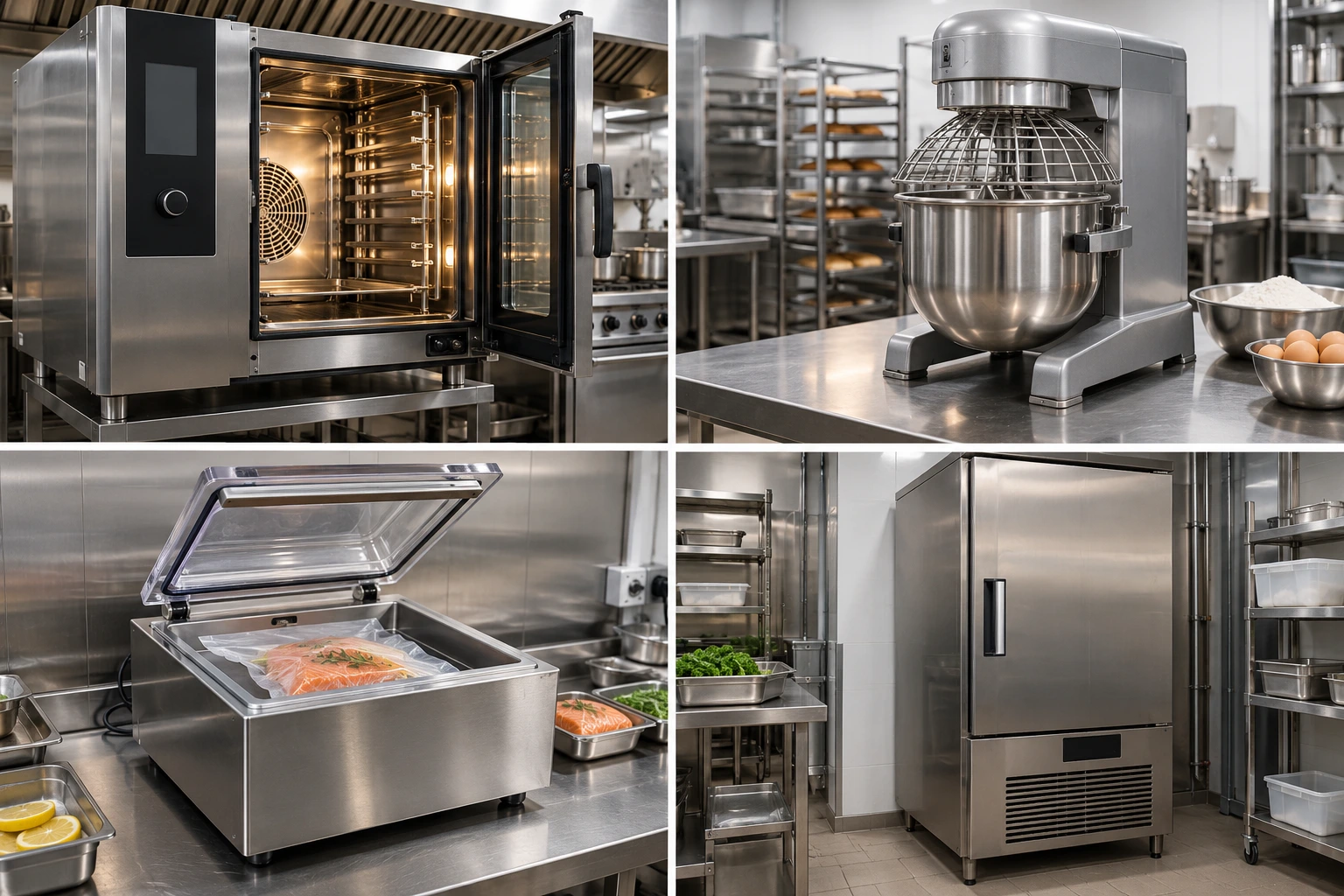
PSG’s supportable equipment list is organised by sector, with separate categories for food services and food manufacturing. For a commercial kitchen, a handful of categories come up repeatedly.
Cooking and Combi Oven Equipment
Combi ovens, which combine convection, steam and combination cooking modes in a single unit, are among the most commonly claimed items under the food services category. A combi oven reduces reliance on manual monitoring, standardises cooking outcomes across shifts, and cooks and reheats a wide range of dishes from one appliance, the kind of labour and consistency gain the grant is designed to support.
Food Preparation Equipment (Mixers and Similar)
Planetary and spiral mixers, used for dough, batter, whipped toppings and similar preparations, also appear on the supportable equipment list. As with every category, the specific model must meet the published specifications, and you should check eligibility against the current GoBusiness Gov Assist catalogue rather than assuming it based on a previous purchase or a visually similar product.
Food Safety and Packaging Equipment
Vacuum packaging machines sit under this category because they serve a dual purpose assessors look for: extending shelf life and reducing spoilage (a productivity gain) while supporting more consistent food safety practices. Suppliers such as Jackie’s carry equipment categories, including combi ovens, mixers, vacuum packaging machines, and blast freezers, that commonly appear on PSG-type equipment lists; whether a specific model is currently listed still needs checking against the live GoBusiness catalogue before requesting a quotation.
Cold Chain Equipment (Blast Freezers)
Blast freezers, which rapidly lower food temperature from cooking heat to well below freezing, are typically included for similar reasons: faster freezing limits the ice crystal formation that degrades texture and shelf life, supporting both food safety and waste reduction, the two outcomes PSG’s food-sector categories are generally built around.
Equipment That Commonly Falls Outside PSG Scope
Not everything in a kitchen qualifies, and assuming otherwise is a common and costly mistake. General kitchenware and basic utensils are not supported, nor is equipment from a brand or model not on the current pre-scoped list, even if it performs a similar function to an approved item. Bespoke configurations of otherwise-approved equipment are excluded too, since PSG is built around standard, off-the-shelf specifications rather than tailored builds. Most importantly, you cannot claim equipment already purchased or committed to before submitting an application; PSG does not support retrospective applications.
How Much of the Cost PSG Actually Covers
Since 1 April 2023, PSG has co-funded up to 50% of qualifying costs, capped at S$30,000 per company per grant year, running from 1 April to 31 March. Once the annual cap is used up, no further PSG support is available until it resets, so a kitchen planning several purchases in one period needs to sequence them deliberately.
The cost cap is set per equipment category based on that category’s mandatory specifications, and the qualifying cost is subject to Enterprise Singapore’s internal assessment; it can be adjusted based on the specific unit’s specifications, so the published cap is a ceiling rather than a guaranteed payout. The table below sets out what is currently confirmed for two food-services categories, with a reminder to verify other categories directly.
Equipment category | Cost cap under PSG (per unit) | What to check before quoting |
Up to S$37,500 | Cap reflects the mandatory technical specification for this listing | |
Automated deep fryer | Up to S$4,000 | Applies to units with pre-set frying controls and an automatic lifting function |
Planetary mixer, vacuum packaging machine, blast freezer | Varies by model and specification | Confirm the current cap for each listing on GoBusiness Gov Assist before requesting a quotation |
Because caps and listings are reviewed periodically, check the figures above against the live GoBusiness Gov Assist listing before finalising a purchase decision, particularly for kitchens comparing several equipment categories against a single annual cap.
How the PSG Application Process Works
The sequence matters as much as the eligibility criteria. Applying in the wrong order is one of the most common reasons a PSG claim is rejected.

Selecting a Pre-Approved Vendor and Getting a Quotation
The first step is to identify the relevant equipment category on GoBusiness Gov Assist and obtain a formal quotation, whether from a pre-approved vendor (for IT solutions) or a supplier offering equipment that meets the published specifications. This quotation is submitted as part of the application, so it needs to reflect the actual configuration intended for purchase, not a placeholder estimate.
Submitting the Application via the Business Grants Portal
The application is submitted through the Business Grants Portal (BGP), using a Corppass account linked to the company’s UEN. This is the only official channel: applying directly to a vendor or supplier, however well-established, does not constitute a PSG application. This route also has a hard deadline. Enterprise Singapore has confirmed that PSG, alongside the Enterprise Development Grant and the Market Readiness Assistance grant, will stop accepting new applications from 29 September 2026, with a replacement scheme, the EDGE Grant, opening from 30 September 2026. Applications already submitted before that date will continue to be processed, and claims can still be filed once the project is complete, but no new PSG applications will be accepted after the cut-off. Kitchens weighing a PSG application should factor this timeline into their decision now.
Why You Cannot Sign, Pay, or Deposit Before Approval
This is one of the most common reasons a PSG claim is voided. No payment, deposit or signed commitment to a vendor may be made before the PSG application is submitted; doing so makes the application retrospective, and retrospective applications are not supported. The quotation comes first, the application second. Once submitted, a business may proceed with the purchase while the outcome is pending, but on the understanding that if the application is later rejected, no claim can be made for costs already incurred.
Approval Timeline and Post-Approval Steps
Applications are generally processed within about six weeks of submitting all required information, and early submission is encouraged to allow for this. Once approved, the equipment must be purchased, used and paid for in full before a claim is filed, and only one claim is permitted per approved application. Approved equipment must also be held and used for a minimum period after the final claim is approved, so PSG is not well suited to equipment a kitchen expects to replace shortly after installation.
Common Mistakes That Delay or Disqualify a PSG Claim
Several patterns repeatedly show how F&B kitchens lose PSG support, even when the underlying purchase would otherwise have qualified. One of the most common and costly mistakes is paying a deposit, signing a contract, or otherwise committing to a vendor before the application is submitted; this is treated as retrospective, regardless of intent. Another is choosing a model variant not on the current pre-scoped list; a near-identical unit from the same supplier is not automatically interchangeable with the listed model. A third is a mismatch between the company’s registered UEN and the entity named on the quotation or invoice, which can stall a claim even when every other condition is met. Incomplete documentation, particularly missing or outdated financial statements for companies without audited accounts, is another recurring cause of delay. These are commonly reported patterns rather than findings from a specific audited case, and businesses should confirm any claim-specific requirement directly with Enterprise Singapore or the BGP helpdesk before submitting.
PSG Versus Other F&B Equipment Grants
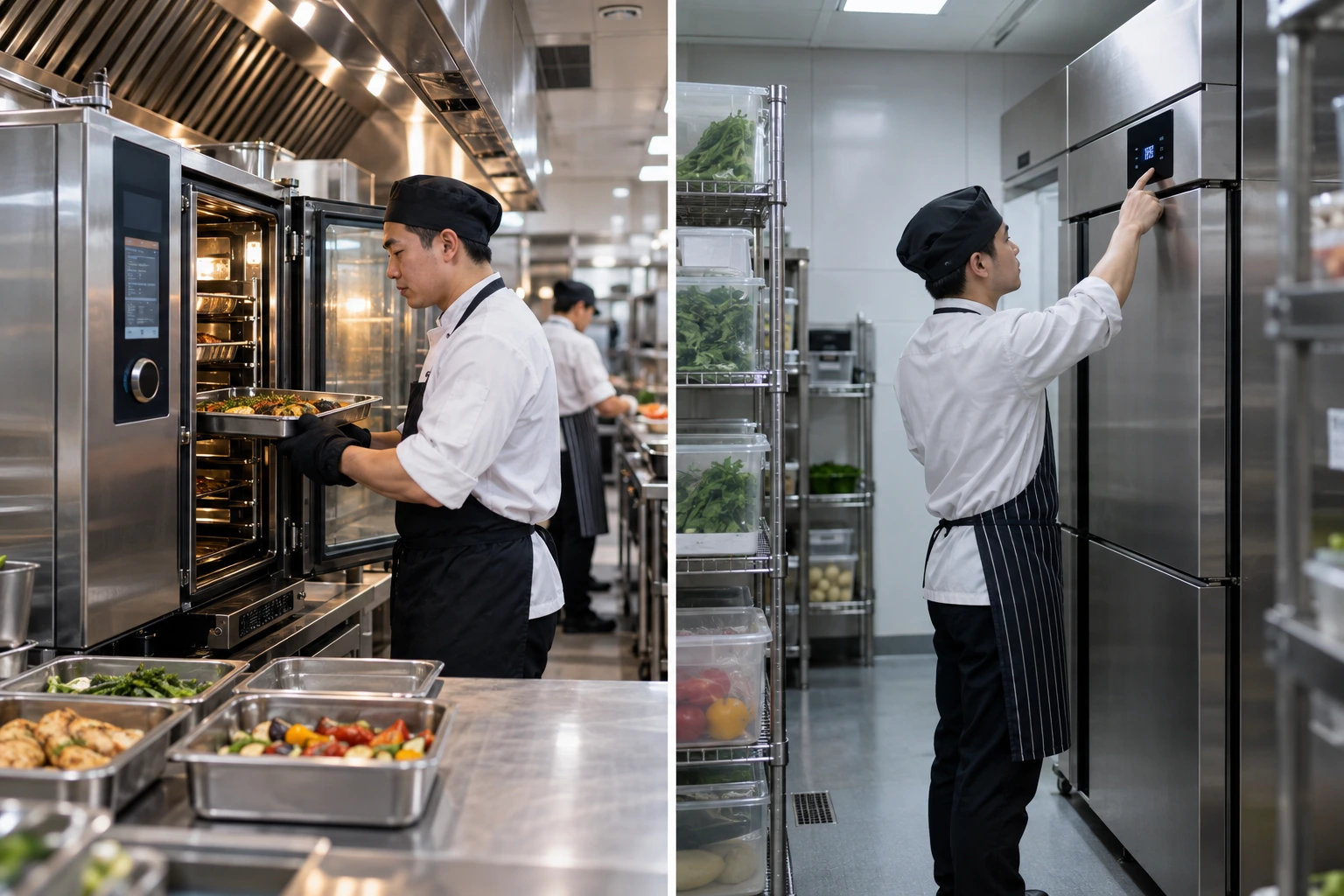
PSG is not the only funding route for F&B kitchens, and conflating it with other schemes is a common source of confusion. The Energy Efficiency Grant (EEG), for example, targets a different outcome: it co-funds pre-approved energy-efficient equipment, such as refrigeration, air-conditioning and certain cooking and dishwashing equipment, with support levels and categories set independently of PSG. Because the two schemes cover different equipment lists and separate criteria, a kitchen weighing an energy-efficient upgrade against a productivity-focused purchase, such as a combi oven, may find one scheme fits better, or that a purchase qualifies under only one of the two. Confirm grant-stacking rules and any overlap directly with Enterprise Singapore or the National Environment Agency, since these conditions can change between grant cycles.
Conclusion
PSG can meaningfully reduce the upfront cost of upgrading a commercial kitchen, co-funding up to 50% of qualifying costs on equipment such as combi ovens, mixers, vacuum packaging machines and blast freezers, up to an annual cap per company. That support depends on getting the sequence right: confirming eligibility, checking that the specific equipment model is currently listed, and submitting through the Business Grants Portal before making any payment or commitment to a vendor. Kitchens considering a purchase should also weigh the scheme’s approaching closure to new applications, and confirm current figures, caps and listings against Enterprise Singapore’s official resources before finalising a decision.