
Why This Is a Different Decision Than “What to Buy”
Most equipment guides assume you’ve already decided on a purchase: which combi oven, which mixer, which freezer. For a lot of F&B operators, that is the wrong starting point. A new hawker stall owner, a pop-up running a six-month lease, or a seasonal kitchen gearing up for a festive period is not really asking which oven to buy. They are asking whether buying is the right move at all, or whether renting gets them the same working kitchen without tying up capital they might need elsewhere.
Deciding whether to rent commercial kitchen equipment in Singapore is a funding-model decision, not a product-selection one, and the two questions deserve separate answers. This guide sets out how renting and buying actually work, compares them on the factors that matter operationally, and helps different types of kitchens work out which path fits their situation.
How Renting Commercial Kitchen Equipment Works
What’s Typically Included in a Rental Agreement
A commercial kitchen equipment rental agreement generally gives the operator use of the equipment for a fixed period in exchange for a recurring payment, with the equipment remaining the property of the rental provider throughout. Maintenance and servicing arrangements vary considerably between providers: some bundle servicing and breakdown cover into the rental fee, while others treat it as a separate cost. Because these inclusions are not standardised across the industry, they need to be confirmed directly with the specific provider before signing, rather than assumed from one rental company’s terms to another’s.
Typical Rental Terms and Contract Lengths
Rental arrangements are usually structured around a fixed term rather than open-ended, ongoing use, with the length of that term varying by equipment type and provider; some kitchens rent month to month, others commit to a longer period to secure a better rate. As with servicing inclusions, exact terms should be confirmed with the provider rather than assumed to be uniform across the market.
How Buying Commercial Kitchen Equipment Works
Upfront Ownership and What It Includes
Buying outright means paying the full purchase price at the point of sale and owning the equipment from day one, with no recurring payment obligation attached to that unit afterwards. The trade-off is that maintenance, repairs, and eventual replacement all sit with the owner, not a provider; no servicing safety net is built into the purchase unless the buyer arranges a separate maintenance contract or warranty.
Renting vs Buying: A Side-by-Side Comparison
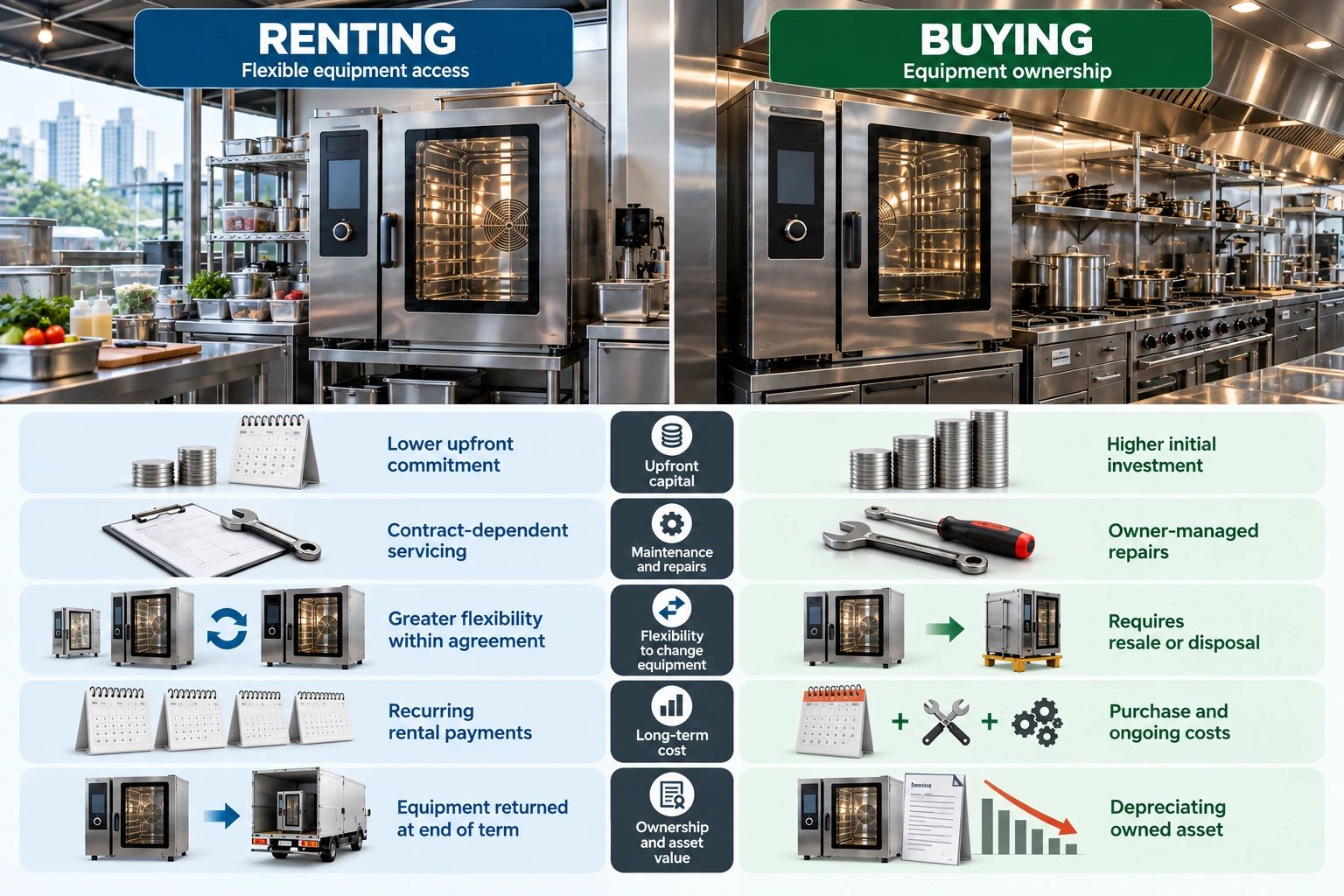
Reduced to the factors that actually affect day-to-day operations, the two paths compare as follows.
Factor | Renting | Buying |
Upfront capital | Low; a deposit and recurring payments rather than the full price | Full purchase price (or loan repayment) paid upfront or over financing |
Maintenance and repairs | Often included or arranged by the provider, depending on the agreement | Owner’s responsibility and cost |
Flexibility to change equipment | Generally easier; equipment can often be swapped as the agreement allows | Requires reselling or disposing of the owned unit |
Long-term cost | Typically higher over an extended period of continuous use | Typically lower over the equipment’s full working life, once paid off |
Ownership and asset value | None; equipment is returned at the end of the term | Builds a depreciating but owned asset on the business’s books |
Upfront Capital and Cash Flow
For a startup or a pop-up with limited working capital, the difference between paying the full price of a combi oven upfront and spreading that cost as a smaller recurring payment can be the difference between opening on schedule and delaying for want of cash. Renting keeps more capital free for stock, staffing and marketing in the early months, when cash flow is often tightest and least predictable.
Maintenance, Repairs, and Breakdown Risk
A breakdown mid-service is a different problem depending on who owns the equipment. Under many rental agreements, the provider is responsible for repairing or replacing a faulty unit, which limits the operator’s downside if something fails. Under ownership, the repair bill and the downtime both land on the business, and there is no guarantee of a quick fix unless a separate service contract is already in place.
Flexibility to Scale, Upgrade, or Exit
A kitchen that expects its equipment needs to change, because the menu is still evolving, the space might change, or the business itself might not run past a defined season, benefits from the flexibility renting generally offers. Owned equipment is a fixed commitment: scaling down, changing direction or closing the kitchen means disposing of an asset, not simply ending an agreement.
Long-Term Cost Over the Equipment’s Lifespan
Renting is often positioned as the lower-cost option in the short term and the higher-cost option over a long, continuous period of use, since recurring payments accumulate over time in a way a one-off purchase does not. The exact crossover point depends heavily on the specific equipment, the rental rate, and the provider’s terms, so treat this as a general pattern rather than a fixed rule, and work it out against actual quotations rather than assumptions.
Ownership, Equity, and Asset Value
Buying builds an asset on the business’s books, even as that asset depreciates in value over time; it can also be resold, if only for a fraction of the original price. Renting builds no equity at all: at the end of the term, the equipment goes back, and the business has nothing to show for the payments beyond the use it got out of the arrangement.
Which Option Fits Which Type of Business
New F&B Startups and First-Time Operators
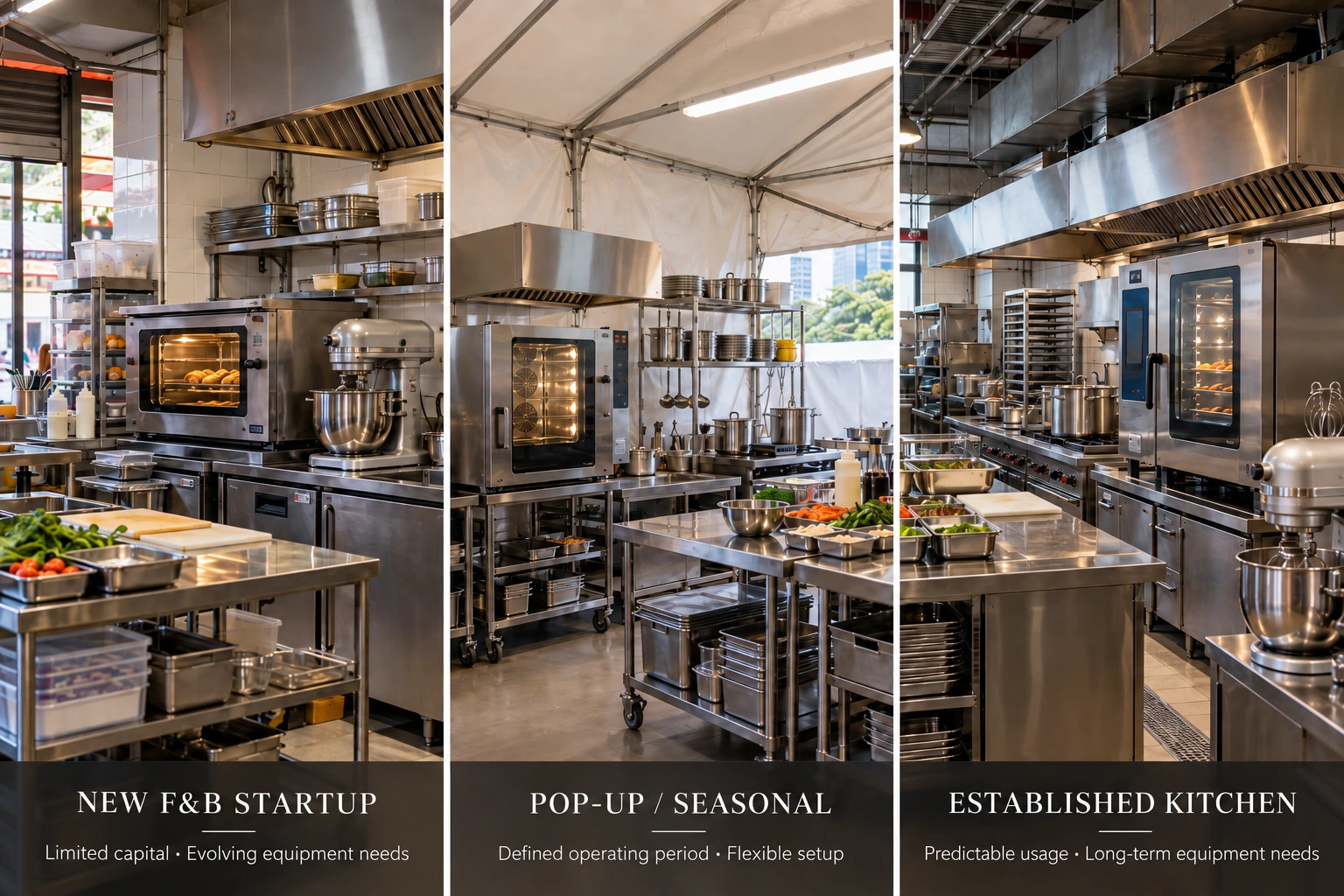
Early-stage operators are often working with limited capital and genuine uncertainty about which equipment configuration they will need once the kitchen is actually running. Renting reduces upfront commitment and makes it easier to adjust the setup once real operating data starts coming in, rather than locking in a purchase decision before the business has proven its own patterns.
Pop-Ups, Seasonal Kitchens, and Short-Term Operations
Where equipment is needed for a defined, limited period, such as a festive pop-up or a short lease, renting avoids the problem of owning equipment with no further use once the period ends. Buying only makes sense here if the equipment has a clear next use after the current one, which is not always the case for a one-off or seasonal setup.
Established Kitchens Scaling Up or Replacing Ageing Equipment
For an established kitchen with predictable throughput that expects to keep using the same equipment for years, the long-term cost advantage of ownership usually outweighs renting’s flexibility. Replacing an ageing combi oven that the kitchen will keep for its full working life is a different decision from equipping a kitchen that might not exist in its current form a year from now.
Equipment Types Better Suited to Renting vs Buying
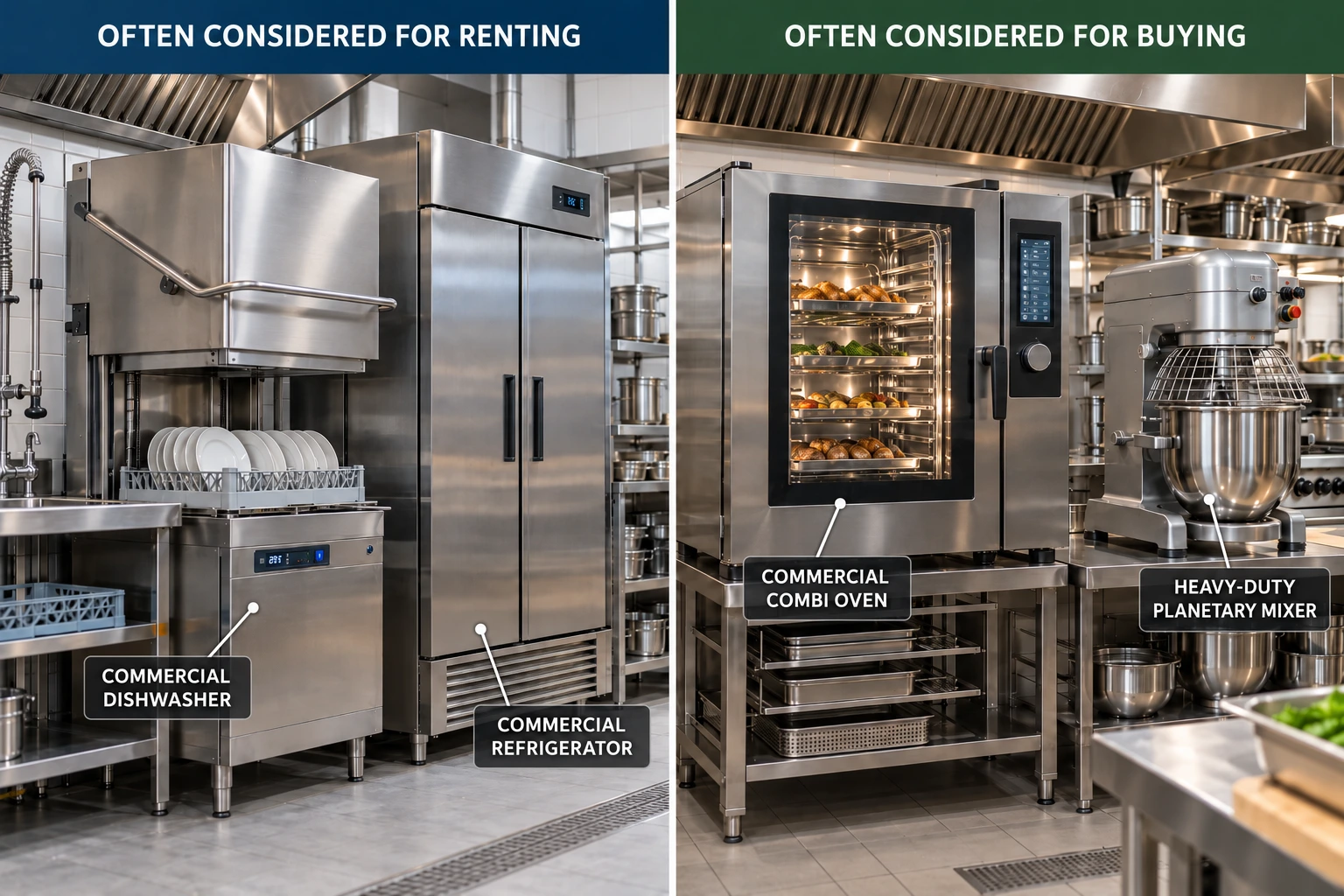
As a general pattern rather than a fixed rule, equipment that is frequently updated, heavily serviced, or subject to rapid technology change, such as dishwashers and some refrigeration units, tends to suit renting, since it makes upgrading to newer models straightforward without a resale process. Stable, long-lifespan “workhorse” equipment that a kitchen will use in largely the same configuration for years, such as a core combi oven or a heavy-duty mixer, more often suits buying, since the equipment’s working life comfortably outlasts any rental term and ownership becomes the cheaper option over that horizon. This is a starting point for narrowing the decision, not a substitute for assessing the specific equipment category against the business’s own expected usage.
Questions to Ask Before Choosing Either Path
Before committing to either route, work through a short set of practical questions: how long is the equipment actually needed for, and is that period fixed or open-ended?
How stable is projected revenue over the next year, and how much cash can you comfortably tie up in equipment rather than keep liquid?
Will this equipment still fit the kitchen’s operations in two to three years, or is the business likely to outgrow or restructure around it?
For operators leaning toward buying, does financing or grant support change the underlying calculation, for instance through an equipment or fixed asset loan under the Enterprise Financing Scheme, or co-funding for specific pre-approved equipment under the Productivity Solutions Grant?
Operators evaluating this decision can also consult a supplier such as Jackie’s, which offers a kitchen equipment rental service alongside outright purchase, to compare actual terms against the factors set out above.
Conclusion
Neither renting nor buying is universally the right answer. The decision comes down to how much capital the business can commit upfront, how long the equipment is genuinely needed, and whether the equipment category suits ownership or benefits from the flexibility of a rental agreement. A pop-up with a six-month runway and a fifteen-year-old established kitchen replacing a workhorse oven answer the same question with different information, and the right choice follows from that context rather than a general rule. What matters is working through the comparison against the business’s own numbers and timeline, rather than defaulting to whichever option looks cheaper at first glance.