Why Combi Ovens Fail Early, and What Descaling Has to Do With It
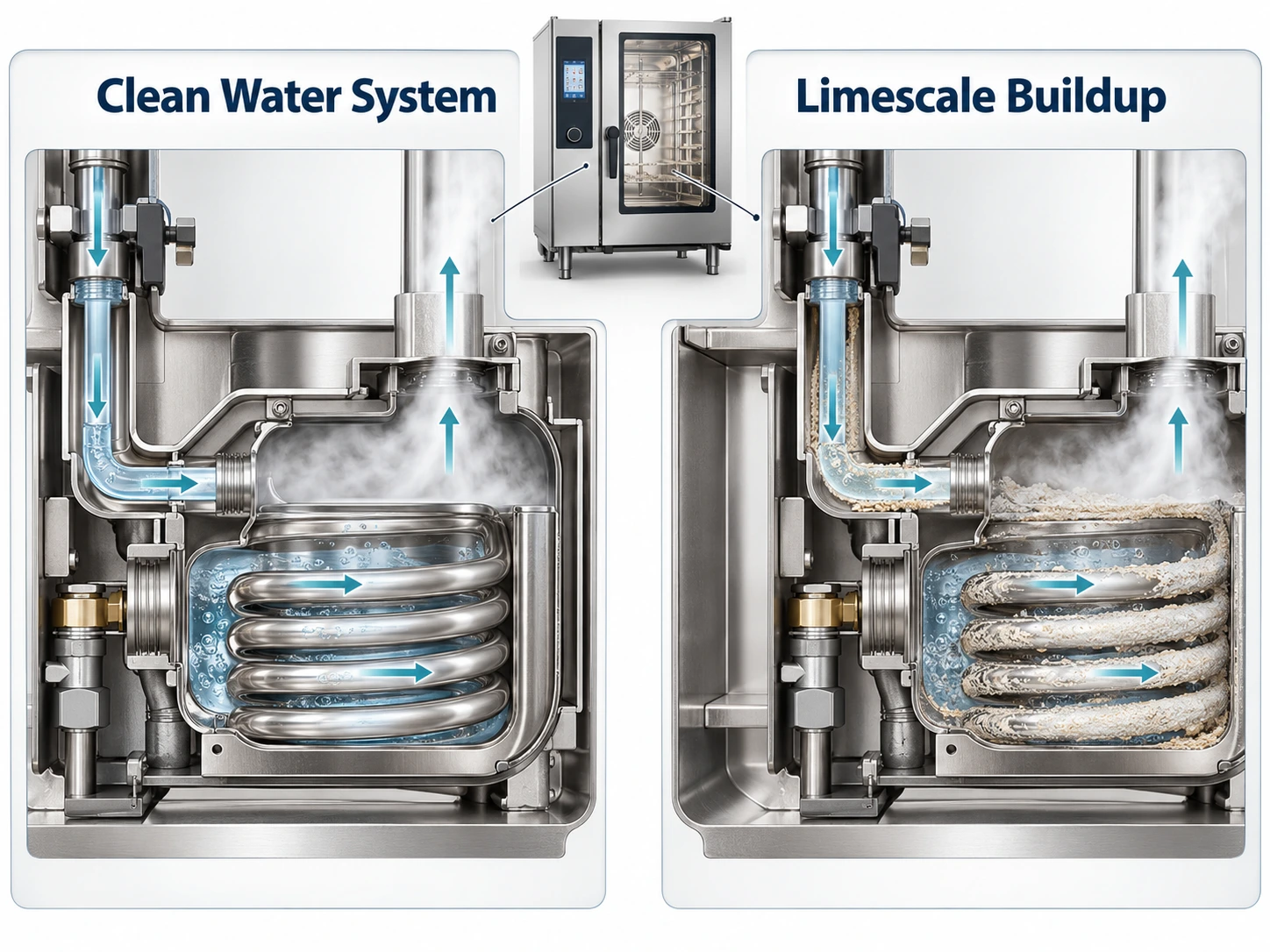
A combi oven is a major investment, and the first signs of trouble are often small: weaker steam, error prompts, longer cook times. Limescale is a common contributor to these problems because the oven heats water to make steam, and the minerals in that water are left behind.
Combi oven maintenance and descaling go well beyond wiping down the cabinet. This guide explains how scale forms, how Rational and Unox care systems differ, what a sensible routine looks like, and when a symptom needs a technician instead of another cycle.
How Scale Builds Up Inside a Combi Oven
Understanding the mechanism explains why the steps matter, and why skipping them tends to cost more later.
Where Limescale Forms (Steam Generator, Cabinet, Water Pathways)
Scale collects wherever heated water evaporates or sits: the steam generator, the cooking cabinet and the water pathways between them, including the humidifying nozzle on some models. Common indicators of neglect include reduced steam, scale or care prompts on the display, longer cook times and extra strain on components. These are signals to investigate, not diagnoses; other faults can look similar.
Some Rational models display a limescale warning, which is an instruction rather than a suggestion.
Water Quality and Hardness
Hardness is the amount of dissolved calcium and magnesium in water. Harder water and heavier use mean scale forms faster.
PUB, Singapore’s national water agency, publishes drinking water quality data. For 2023, total hardness of water leaving the waterworks and desalination plants averaged 43 mg/L as calcium carbonate, within a reported range of 19 to 203 mg/L. Unox spec sheets for several models set a steam circuit limit of 8 °dH (about 142 ppm), so the top of that range is above it. The figures describe water at the plants, not necessarily at your oven, because building pipework and storage can change what arrives.
Manufacturers also take different positions on treatment. In a 2017 interview, Rational said its care system removes the need for a softener on CareControl models, even with very hard water. Your own supply and your model’s manual are the deciding evidence.
Know Your Oven: Rational and Unox Care Systems Differ
Combi ovens are not all descaled the same way, and the two brands take different approaches. Within each brand, newer and older models can differ too.
Feature | Rational | Unox |
Automatic system | Efficient CareControl on iCombi Pro, iCombi Classic and SelfCookingCenter models fitted with it | ROTOR.Klean automatic washing, with SENSE.Klean suggesting a cycle |
Consumables | Rational care tabs on CareControl models; Rational liquid descaler on manual models such as the CombiMaster Plus | DET&Rinse detergents, loaded into an integrated container |
Manual descaling | Required on some models, such as the CombiMaster Plus | Confirm in your model’s manual |
Water treatment | Manufacturer states no softener is needed on CareControl models | Spec sheets list hardness limits; PURE filtration is offered |
Rational Ovens: Automated Care Systems vs Manual Descaling Models
On models with Efficient CareControl, Rational describes an oven that detects dirt and limescale, selects a cleaning cycle and recommends the quantities of cleaner and descaler. Operators follow the on-screen recommendation and load Rational’s tabs.
Other models work differently. For the CombiMaster Plus, Rational’s descaling note says the steam generator must be descaled regularly, and that service can remove only heavier deposits. Which system your oven has depends on the model, so check its name against Rational’s current documentation.
Unox Ovens: Integrated Cleaning and Maintenance Features
Unox spec sheets describe ROTOR.Klean, an automatic washing system, with SENSE.Klean estimating how dirty the oven is and suggesting a wash cycle. Detergent is held in an integrated DET&Rinse container, and optional PURE filtration is listed to reduce the minerals that form limescale.
Do not assume this mirrors Rational’s system. Descaling and water treatment steps are model-specific, so confirm them against Unox documentation for your oven.
Why the Manufacturer’s Manual and Specified Consumables Come First
Rational says it recommends only its own agents because its cleaning system coordinates the tabs, time and water to clear scale and leave no residue. Using other chemicals can affect how a cleaning cycle performs. Whether a substitute affects components or your warranty is a question for the manufacturer’s or your supplier’s terms, so check both before changing products.
A Practical Descaling and Care Routine
This routine covers what to do, what to watch for and how to stay ahead of scale. Your model’s manual provides the exact steps and intervals.
Daily and Weekly Care Habits That Prevent Scale Problems
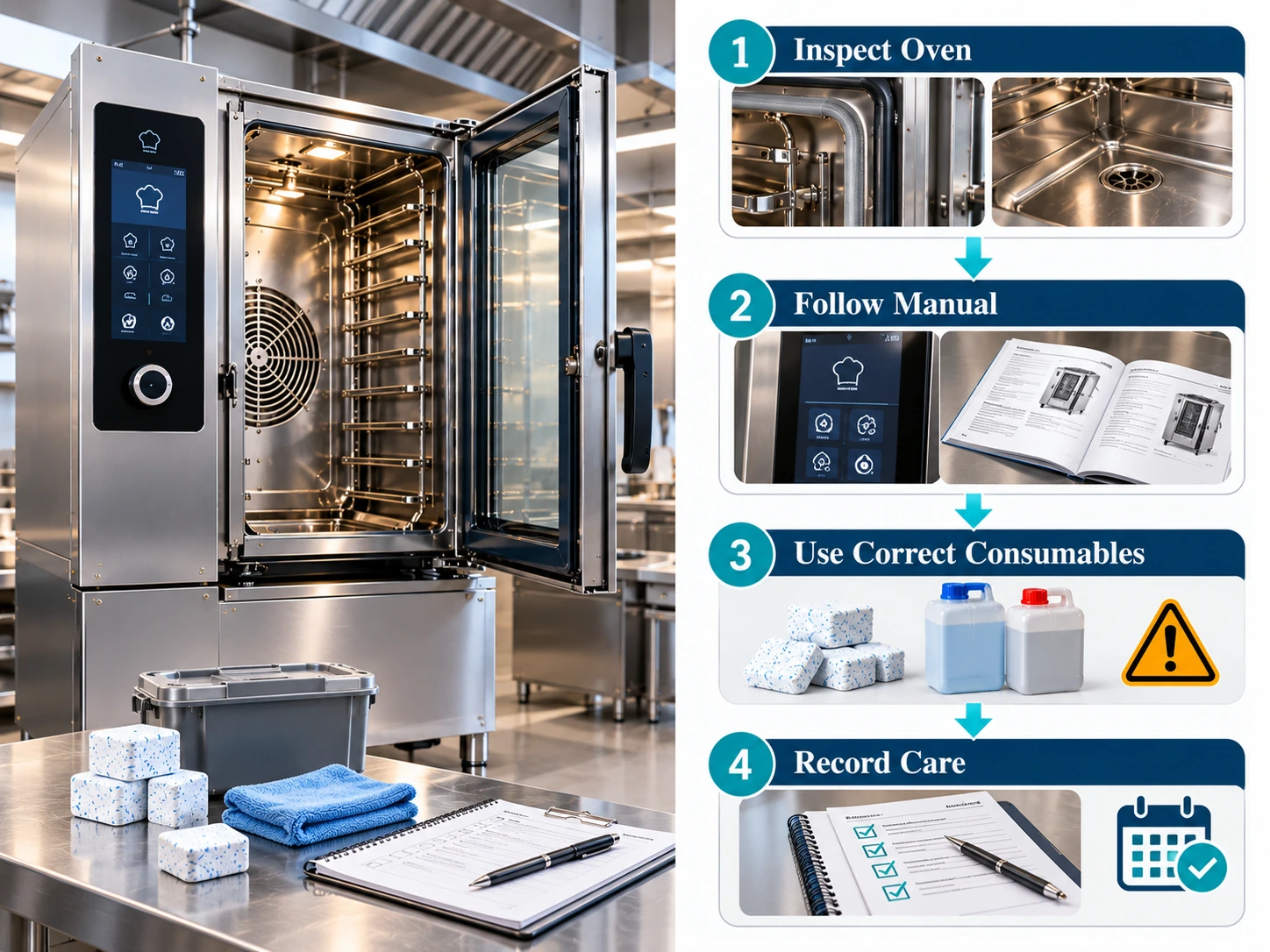
Most protection comes from habits operators control. Respond to cleaning and care prompts when they appear rather than dismissing them. Check the door seal and drain for residue or blockage. If your oven has a water filter, follow the manual’s instructions. Keep a short log of prompts, cycles run and any odd behaviour, which also helps a technician later.
Running a Descaling or Care Cycle Correctly
The general sequence is the same across models: use the product the manufacturer specifies, select the cycle the oven or manual calls for, prepare the cabinet as instructed, and let the cycle finish. Do not interrupt it or skip prompts. Rational’s descaling note for the SelfCookingCenter says to always use the manufacturer’s descaling agent and accessories. Read the product label and safety data sheet, and wear the specified protective equipment. Button-by-button steps vary by model, so follow your manual.
Water Filters, Softeners and Inline Treatment
Water treatment equipment may be recommended, depending on the model and the local supply. Rational states that CareControl models do not need a softener. Unox lists filtration options for its ovens and sets water limits per model. Your oven’s manufacturer guidance decides, not a general rule.
Common Mistakes That Shorten a Combi Oven’s Life
These are commonly reported patterns, not verified client cases, and the scenario below is hypothetical.
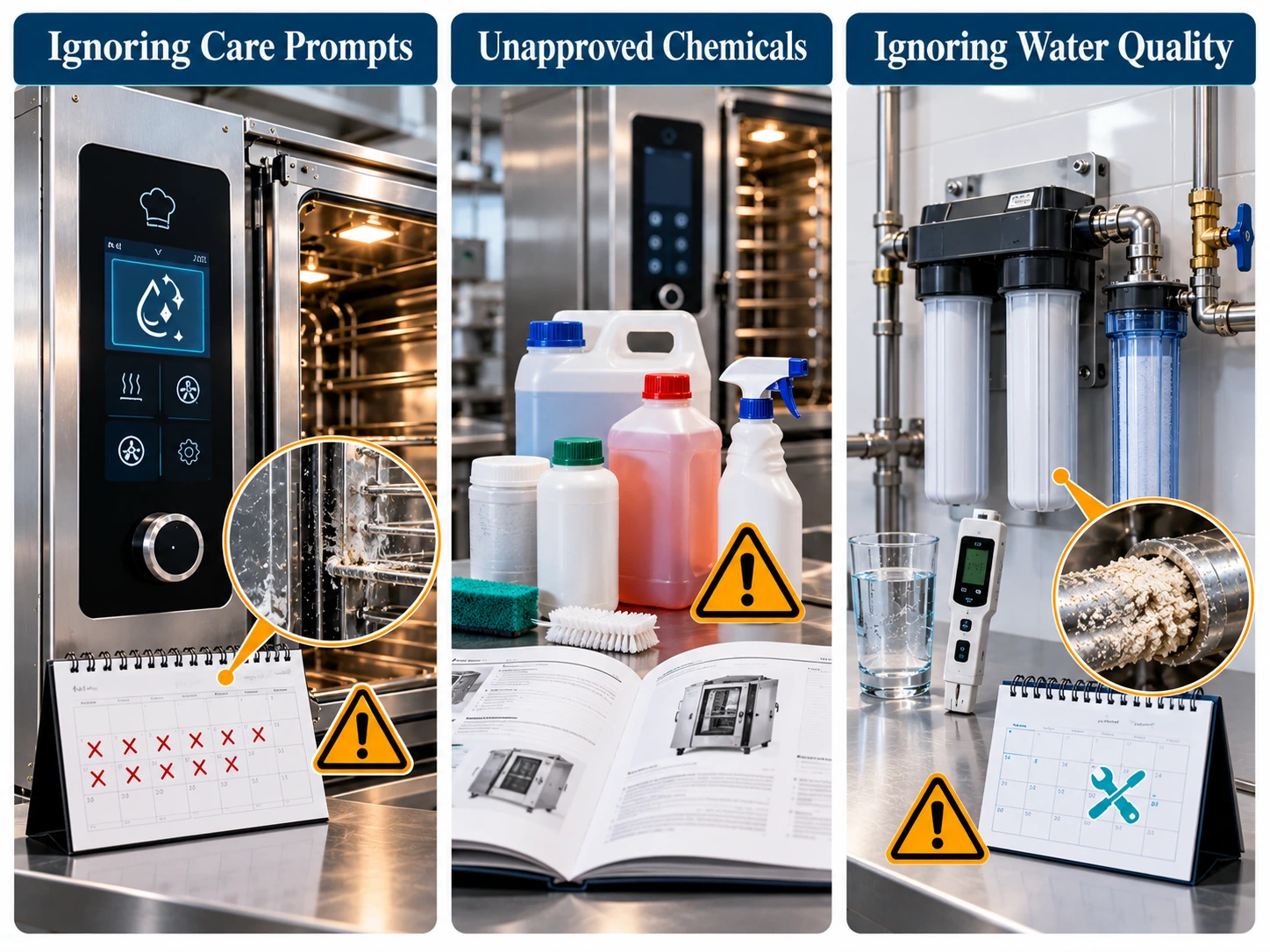
Ignoring Care Prompts or Postponing Cycles
Imagine a kitchen in a busy fortnight that keeps postponing the oven’s requested cycle. Each deferral lets more scale accumulate.
Using Non-Approved Chemicals or Shortcuts
A cheaper product or a shortened cycle can seem harmless. Rational states that only its own agents ensure the oven is fully cleaned and descaled. The manufacturer must confirm whether a substitute causes other problems, so ask before trying alternatives.
Neglecting Water Supply Quality
Water conditions can change without anyone noticing: a different source, a filter past its useful life, or a supply that never matched the manual’s limits. Unmonitored water can cause recurring faults, so check the filter’s status and the water specifications in your manual.
Warning Signs That Need a Technician, Not More Descaling
Some symptoms point to a fault that a cycle will not fix. Persistent error codes, weak or inconsistent steam after a completed cycle, leaks, and unusual noises all deserve a technician. Repeating descaling in these cases does not address the cause. Rational’s own CombiMaster Plus note says heavier limescale deposits in the steam generator need service, not another operator cycle.
As a distributor of Rational and Unox, Jackie’s offers repair and maintenance support for these ovens.
Service Intervals and Professional Maintenance
Operator care and professional servicing do different jobs. Routine habits keep scale and residue in check day to day. Periodic servicing typically adds what operators cannot: inspection of internal components, treatment of deposits beyond routine care, checks on sensors and safety devices, and a review of water treatment equipment.
Servicing is an ownership cost, so plan for it. Recommended intervals and costs depend on the model and usage, so ask the manufacturer or distributor for the schedule that applies to your oven.
Conclusion
Limescale is the main threat to a combi oven, and how to manage it depends on the brand and model. Rational and Unox use different care systems, so check which one yours has. The manual and the manufacturer’s specified consumables govern what you use, and responding promptly to care prompts keeps scale in check between services. Persistent faults call for a technician. Start by identifying your oven’s care system and what your manual specifies for it.