

The Six Commercial Refrigerator Types Available in Singapore
Type 1: Upright Reach-In Refrigerators
What They Are and What Operations They Suit
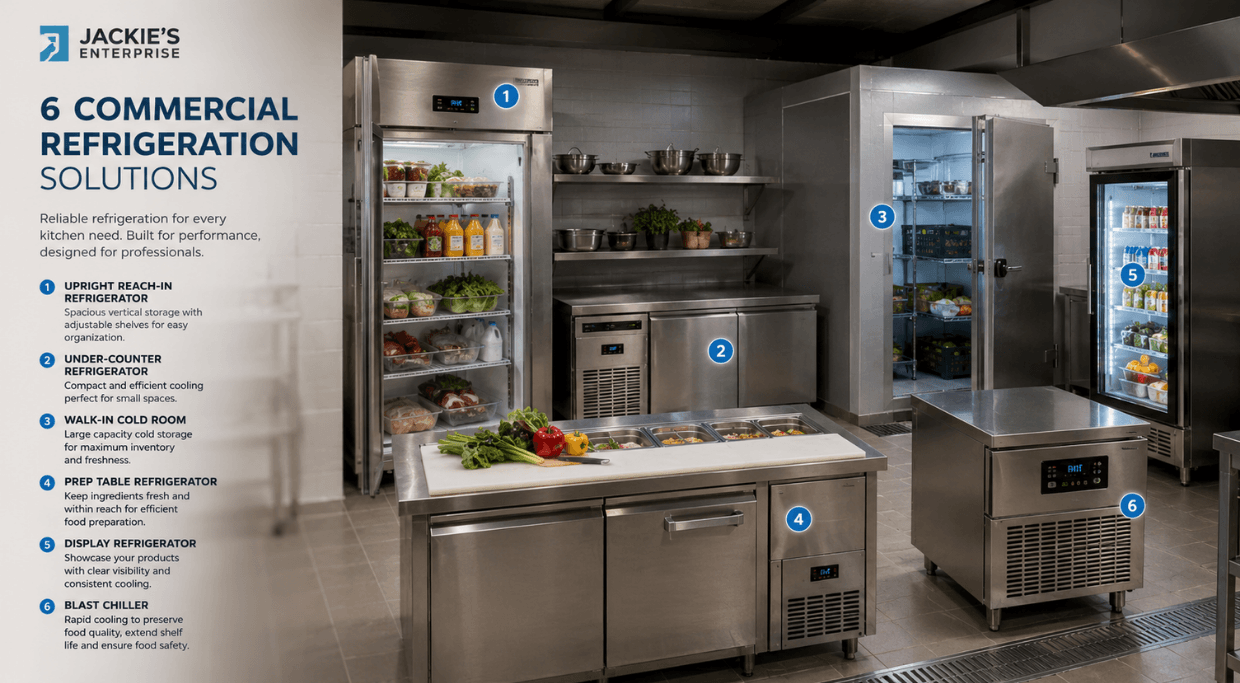
Upright reach-in units are floor-standing cabinets with one or more solid or glass doors, the most common type in Singapore commercial kitchens. They maintain between 1°C and 7°C, with well-specified units achieving 4°C or below for raw meat compliance. They suit restaurants, hawker operations, and cloud kitchens where bulk ingredient storage is the primary function.
Single-Door vs Two-Door vs Four-Door: How to Choose
Single-door units (approximately 500 litres) suit compact cafés and single-station operations. Two-door units (approximately 1,000 to 1,200 litres) are the most versatile for most Singapore restaurant and café kitchens. Four-door units (approximately 1,800 to 2,400 litres) suit high-volume operations and central kitchens requiring separate compartmentalisation by food category.
Type 2: Under-Counter Refrigerators
What They Are and the Kitchen Layouts That Benefit Most
Space is the constraint that makes under-counter units the correct choice for Singapore’s compact commercial kitchens. These low-profile cabinets are designed to fit beneath a work surface, typically 600mm to 900mm high to align with standard counter height. They maintain 1°C to 7°C, with quality units reaching 4°C for raw protein storage, keeping frequently accessed ingredients at the operator’s level without requiring movement during service.
Why Under-Counter Units Are Popular in Singapore’s Compact Commercial Kitchens
Singapore’s commercial kitchens, particularly in hawker centres, food courts, and shophouse F&B spaces, have constrained footprints. Under-counter units use vertical space below the counter without taking up wall or standing space. They integrate into custom stainless steel counter fabrication, creating a seamless food-safe work surface above refrigerated storage below.
Type 3: Walk-In Cold Rooms
When a Walk-In Cold Room Justifies the Cost in Singapore
Walk-in cold rooms are purpose-built insulated rooms maintaining 0°C to 4°C throughout their volume. Above approximately 1,500 to 2,000 litres of required cold storage, a walk-in cold room becomes more economical than multiple reach-in units. It offers better cost per litre, more accessible organisation, and lower total energy consumption per unit of stored volume. Hotel kitchens, large banquet facilities, and central kitchens supplying multiple outlets almost always require walk-in cold rooms.
What NEA and SFA Compliance Looks Like for Walk-In Cold Rooms
SFA requires continuous temperature logging with records available for inspection, appropriate drainage, and materials that can be thoroughly cleaned. In Singapore’s hot kitchen environment, the condensing unit location matters: rooftop installation with direct hot exhaust is preferable to indoor placement, which reduces running efficiency significantly.
Type 4: Counter and Prep Table Refrigerators (Saladette)
What Prep Tables Are and Why They Suit High-Volume Service Operations
Prep tables integrate a refrigerated work surface with a top rail of food pans and a refrigerated cabinet below. The operator accesses all ingredients without leaving the station, significantly improving service speed. Pizza operations, salad stations, poke bowl and sushi operations, and fast-casual burger kitchens in Singapore use prep tables as their primary service refrigeration.
The Temperature Trade-Off: Why Prep Tables Are Not Always Colder
Food in the top rail pans is partly exposed to kitchen ambient temperature. The effective temperature of food in exposed pans is typically 2 to 4°C warmer than the thermostat set point. During slow service, food in top pans may drift above SFA’s 5°C threshold for chilled cooked food. Operators must manage pan rotation and restocking carefully to maintain compliance. Specify a prep table with a covered or enclosed refrigerated top rail rather than a fully open rail.
Type 5: Display Refrigerators and Bakery Cases
What Display Refrigerators Maintain and What Food Types They Suit
Display cases with glass fronts are designed primarily to showcase products to customers. Open-front units typically maintain 4°C to 10°C depending on ambient temperature and product loading. Closed-door display units maintain 2°C to 8°C more consistently. Appropriate food types include beverages, same-day pastries and confectionery, and pre-packaged foods with manufacturer specifications confirming storage above 4°C.
When Display Refrigerators Are Not Sufficient for SFA Compliance
Operators who store raw protein, dairy, or cooked food requiring 5°C or below in open display units frequently discover during SFA inspections that the unit has been maintaining 8°C to 12°C during peak operating hours. Display units should hold food that has been properly stored in a compliant cabinet, not serve as primary storage for temperature-sensitive food.
Type 6: Blast Chillers
What a Blast Chiller Does That a Standard Refrigerator Cannot
No standard refrigerator can cool hot food safely fast enough. A blast chiller solves this with high-velocity cold air circulation that reduces hot cooked food from 70°C to below 3°C within 90 minutes. Placing hot food in a standard unit raises the internal temperature, creates condensation affecting other stored food, and causes the product to pass through the 5°C to 60°C temperature danger zone too slowly for safe cooling. Blast chillers enable cook-chill production: preparing food in large batches, blast chilling, and reheating to order.
When SFA’s HACCP Requirements Make a Blast Chiller Necessary
Operations producing large volumes of cooked food for storage are required or strongly advised to have a blast chiller under SFA’s HACCP framework. Central kitchens supplying multiple outlets, cook-chill and ready-meal producers, and any operation where hot food volume cannot be safely managed in a conventional cabinet need one. Blast chillers are the industry-standard method for meeting SFA’s rapid cooling protocols for higher-risk food operations.
How to Choose the Right Type for Your Singapore F&B Operation
Match Your Food Category to the Correct Temperature Requirement
SFA Temperature Requirements for Different Food Categories
Raw meat and seafood must be stored at 4°C or below. Cooked food held chilled for service must be at 5°C or below. Frozen food must be at -18°C or below. Dairy and highly perishable food must be at 4°C or below. Any unit specified for raw meat or highly perishable storage must be confirmed to achieve and maintain 4°C or below during actual operating conditions, not just at the thermostat set point.
Match Your Kitchen Space to the Right Form Factor
Complete a space assessment before specifying any equipment: total available floor area, ceiling height (relevant for walk-in cold room feasibility), entry point locations (relevant for walk-in cold room access), and service station positions (relevant for under-counter and prep table placement). Kitchen layout and refrigeration specification should be designed together, not sequentially.
Match Your Service Volume to the Right Capacity
The Industry Capacity Guideline for Different F&B Concepts
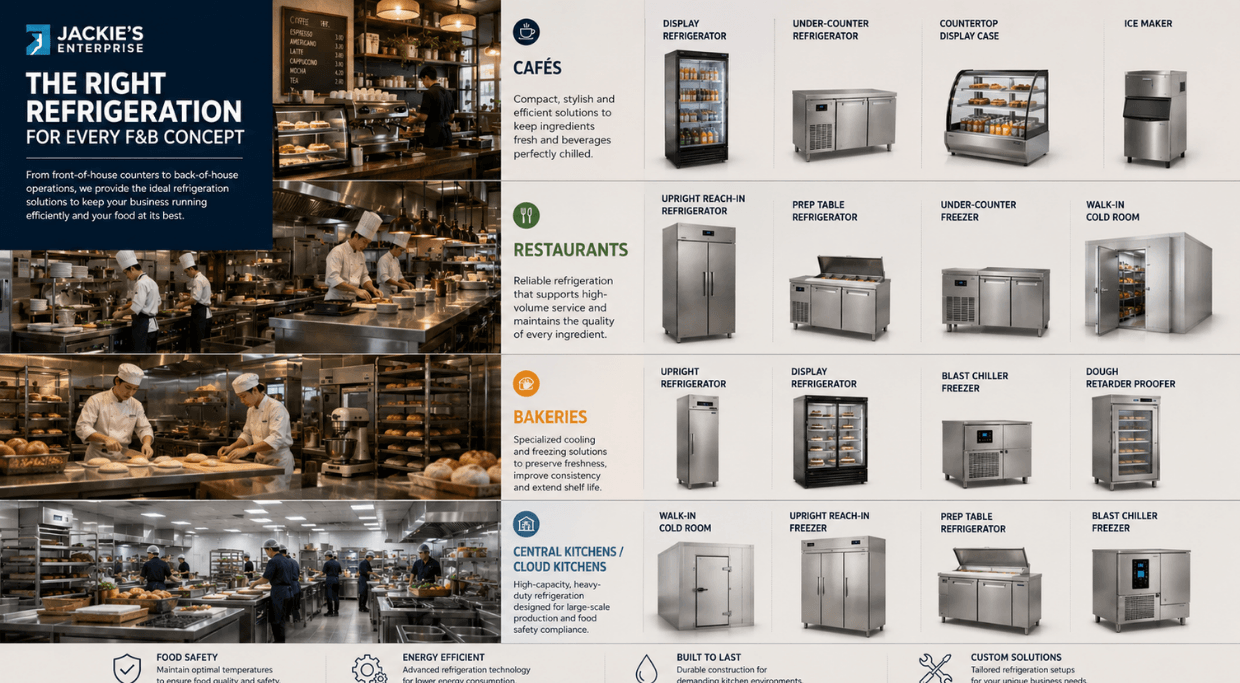
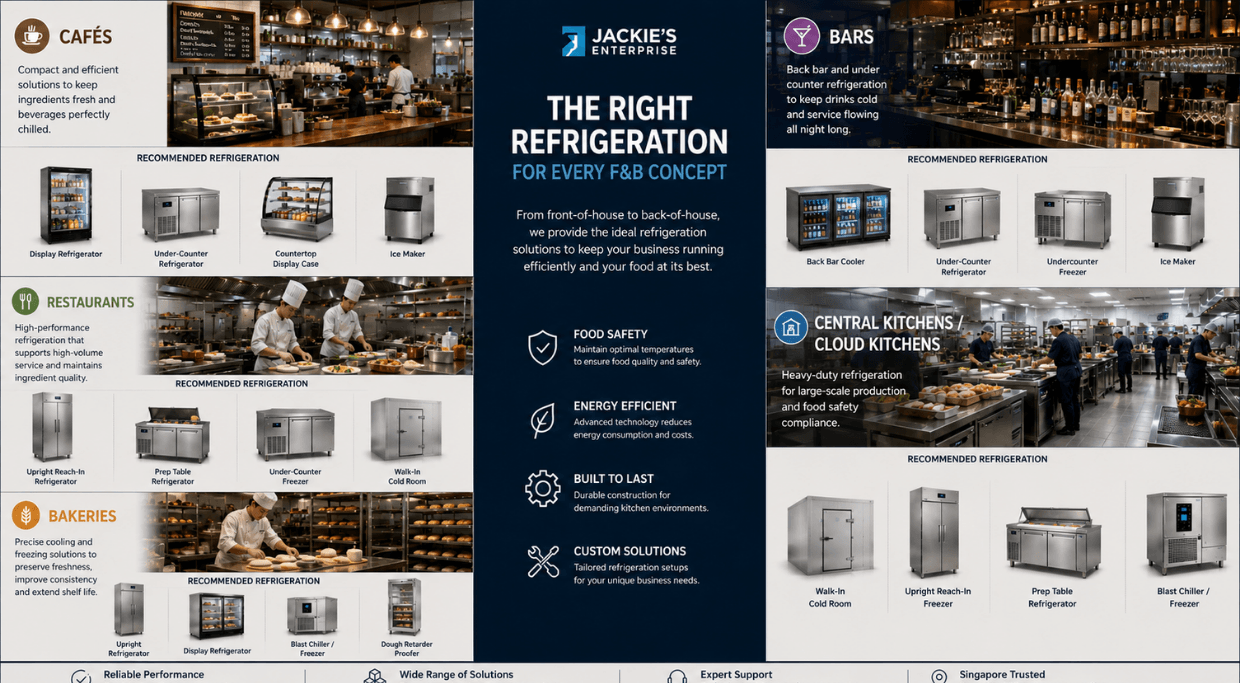
A café operating full-day with a limited food menu typically needs a two-door unit plus one under-counter per service station, adequate up to approximately 100 covers daily. A full-service restaurant needs two to four-door reach-in units plus a prep table at the kitchen line. A central kitchen or high-volume hawker operation above 300 to 400 covers per day almost always requires a walk-in cold room.
Match Your Budget to the Right Refrigeration Investment
Walk-in cold rooms have higher capital cost but lower energy cost per litre of storage than multiple reach-in units. The break-even calculation depends on total volume, delivery frequency, and electricity consumption at Singapore’s commercial tariff rates. Buying on capital cost alone consistently produces the highest total cost of ownership when the unit fails to meet SFA’s required range or requires frequent service intervention.
What to Check for NEA Energy Efficiency and SFA Compliance Before Buying
Confirm whether the unit carries Singapore’s energy efficiency certification from NEA. Higher efficiency ratings reduce electricity operating costs significantly at Singapore’s commercial electricity tariff rates. Confirm the specification sheet states the range the unit achieves under load, not just the thermostat range. Verify internal surfaces are stainless steel and the design allows thorough cleaning without hidden recesses.
Comparison Table: Which Commercial Refrigerator Type for Which Operation
Singapore F&B Operation vs Recommended Refrigerator Type
F&B Operation | Primary Type | Secondary Type | SFA Requirement | Capacity Starting Point |
Hawker / single station | Under-counter or single-door reach-in | None | 5°C or below | Single-door, 500L |
Café | Two-door reach-in | Under-counter per station | 5°C or below | Two-door, 1,000L |
Restaurant kitchen line | Two to four-door reach-in | Prep table at service line | 4°C or below (raw) | Two-door minimum |
Bakery / pastry | Closed-door display case | Two-door reach-in for back storage | 5°C or below | Per display requirement |
Bar / beverage | Under-counter | Display unit for front of house | 5°C or below | Per station count |
Central kitchen | Walk-in cold room | Blast chiller for cooked food | 4°C raw / 5°C cooked | From 1,500L volume |
Cook-chill production | Walk-in cold room | Blast chiller (required) | 4°C or below | Per batch volume |
How Jackie’s Enterprise and Similar Singapore Commercial Kitchen Equipment Suppliers Help Operators Match Equipment to Operation Type
Jackie’s Enterprise is one example of a Singapore commercial kitchen equipment supplier whose advisory process includes matching type to F&B operation, checking SFA compliance against the menu food categories, and advising on kitchen layout integration before equipment purchase is confirmed.
Conclusion
Commercial refrigerator type selection should be driven by food category requirements first, kitchen layout and form factor second, service volume and capacity third, and capital cost last. Upright reach-in units suit bulk ingredient storage, under-counter units integrate into service stations, walk-in cold rooms become economical above 1,500 litres of required storage, prep tables suit high-speed assembly operations, display units are appropriate for customer-facing product presentation with the compliance caveat, and blast chillers are necessary for cook-chill production and SFA HACCP rapid cooling protocols. SFA’s requirements apply throughout: raw meat and perishables at 4°C or below, cooked food held chilled at 5°C or below, frozen food at -18°C or below. Always confirm the unit’s actual operating range under load before purchase, not just the thermostat set point range shown on the specification sheet.