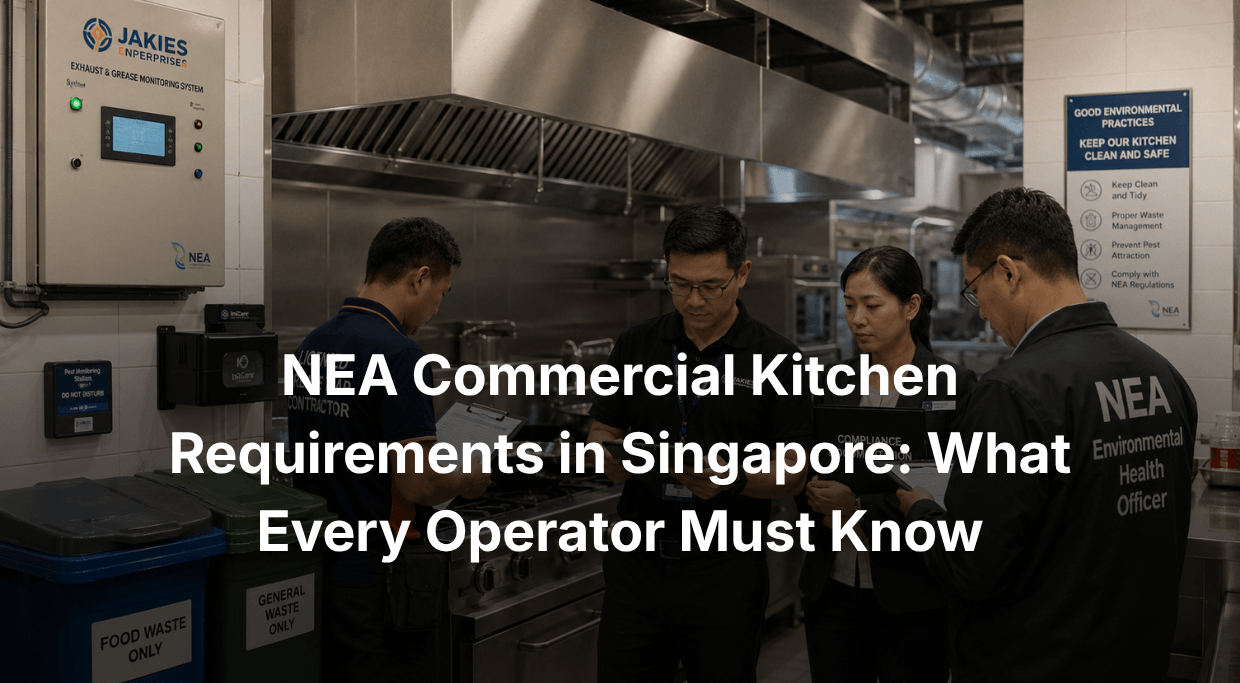
What NEA Is and What Legislative Authority It Has Over Commercial Kitchens
NEA’s Role Under the Environmental Public Health Act
The Environmental Public Health Act (EPHA) gives the authority jurisdiction over public nuisance, sanitation, and environmental hygiene for all commercial premises, including food establishments.
Which Food Premises in Singapore Fall Under NEA’s Jurisdiction
All licensed food establishments fall within scope: restaurants, hawker stalls, food courts, caterers, central kitchens, hotel F&B operations, and institutional catering.
How NEA’s Licensing Conditions Interact With Your SFA Food Establishment Licence
Some requirements are embedded in food establishment licence conditions. When demerit points accumulate past certain thresholds, licence suspension affects trading regardless of SFA status.
NEA’s Specific Requirements for Commercial Kitchen Exhaust Systems
Why Commercial Kitchen Exhaust Is a Primary NEA Compliance Focus
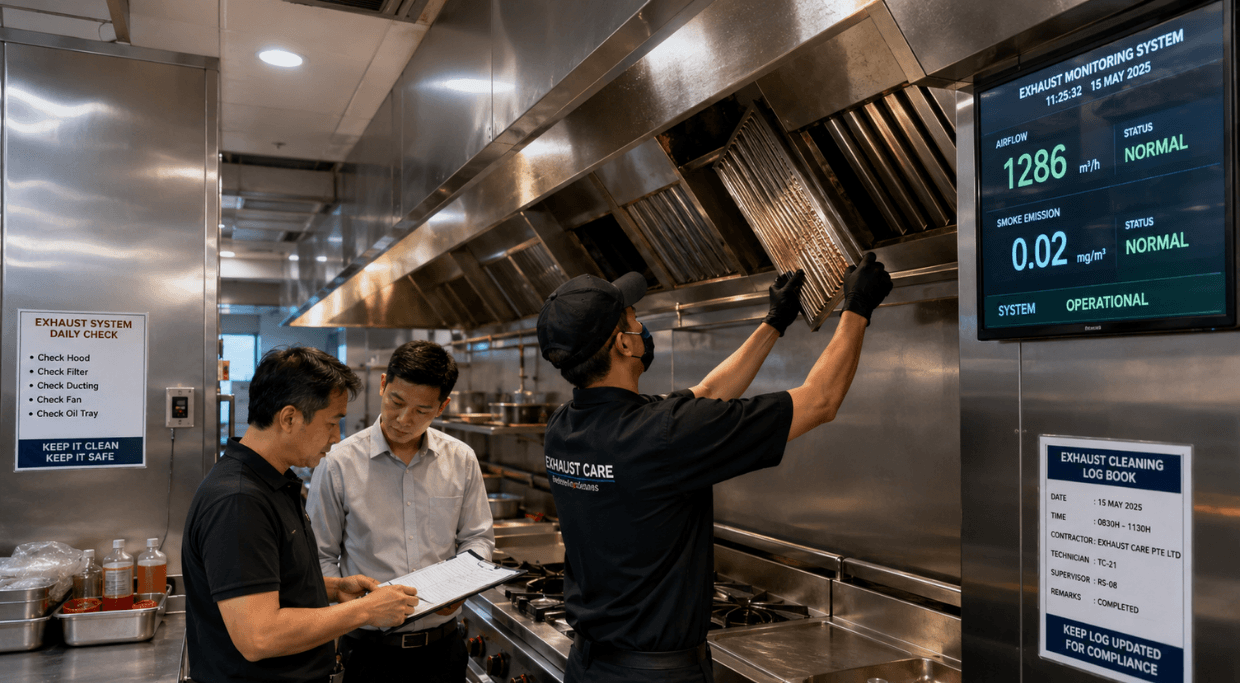
Commercial kitchen exhaust carries grease-laden vapour, odour, and heat into shared spaces, creating both a fire risk through grease accumulation and a public nuisance risk in Singapore’s dense urban environment.
The Exhaust Hood and Ductwork Installation Standards NEA Expects
An exhaust hood must be properly sized with sufficient overhang to capture grease-laden vapour. An undersized or poorly positioned hood creates a compliance failure that cleaning frequency alone cannot remedy.
Exhaust Filter Cleaning Frequency: What NEA Requires and How Often
Cleaning frequency varies with cooking volume and method. High-heat frying operations require more frequent cleaning. “Clean when visibly dirty” is not a compliant standard and is one of the most consistently cited NEA findings.
Exhaust Stack Emission Standards and Smoke Nuisance Provisions
The EPHA’s smoke nuisance provisions require that visible emissions do not exceed the Ringelmann scale standard. A single complaint from a neighbour triggers an investigation regardless of when the last routine inspection occurred.
Documentation Requirements: What to Keep and for How Long
A compliant exhaust maintenance log must record the date, cleaning personnel, method, and filter condition before and after. A contractor’s signed record carries more weight than a self-recorded entry during inspection.
Grease Trap Requirements: What NEA Mandates and What PUB Enforces
Why Grease Traps Are Required for Commercial Kitchens in Singapore
Fats, oils, and grease (FOG) discharged without treatment damage Singapore’s public sewerage network. Both NEA and PUB have jurisdiction: NEA under the EPHA and PUB under the Sewerage and Drainage Act.
NEA and PUB Roles in Grease Trap Compliance: Who Enforces What
NEA ensures a compliant grease trap is installed and maintained. PUB enforces sewerage discharge standards. Addressing one authority’s concerns while ignoring the other does not resolve the compliance position.
Grease Trap Installation Requirements: Sizing, Location, and Access
Trap capacity is determined by flow rate and cooking volume. An undersized trap fills quickly and creates both compliance and operational problems.
Mandatory Grease Trap Servicing Frequency Under Singapore Regulations
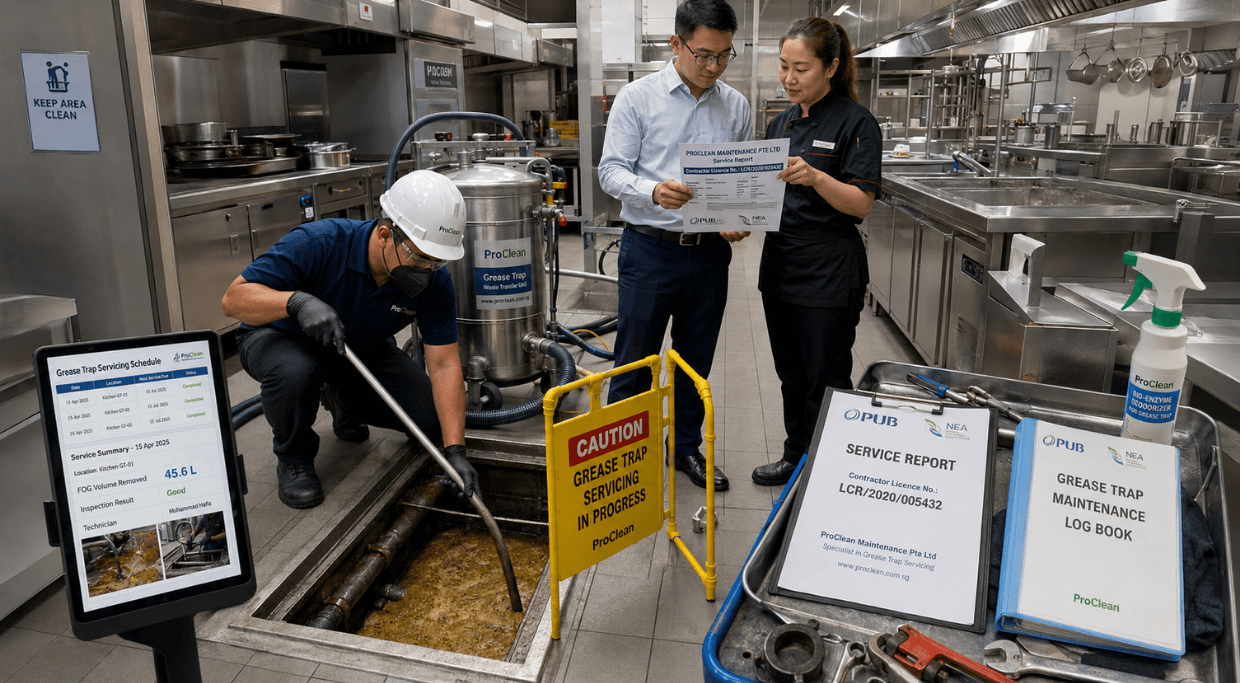
Grease traps must be serviced by a licensed contractor at the required frequency. Self-service by kitchen staff does not satisfy this requirement.
Grease Trap Service Records: What Documentation NEA Inspectors Check
A compliant service record must include the contractor’s identity, NEA licence number, date of service, volume of grease removed, and a condition assessment. Gaps in the record are compliance failures even when the trap appears clean.
What Happens When FOG Discharge Violates Standards
FOG discharge triggers enforcement under the Sewerage and Drainage Act. Composition fines can be levied against the operator, the building owner, or both. A FOG violation also contributes to demerit point accumulation.
Food Waste Management Requirements Under NEA
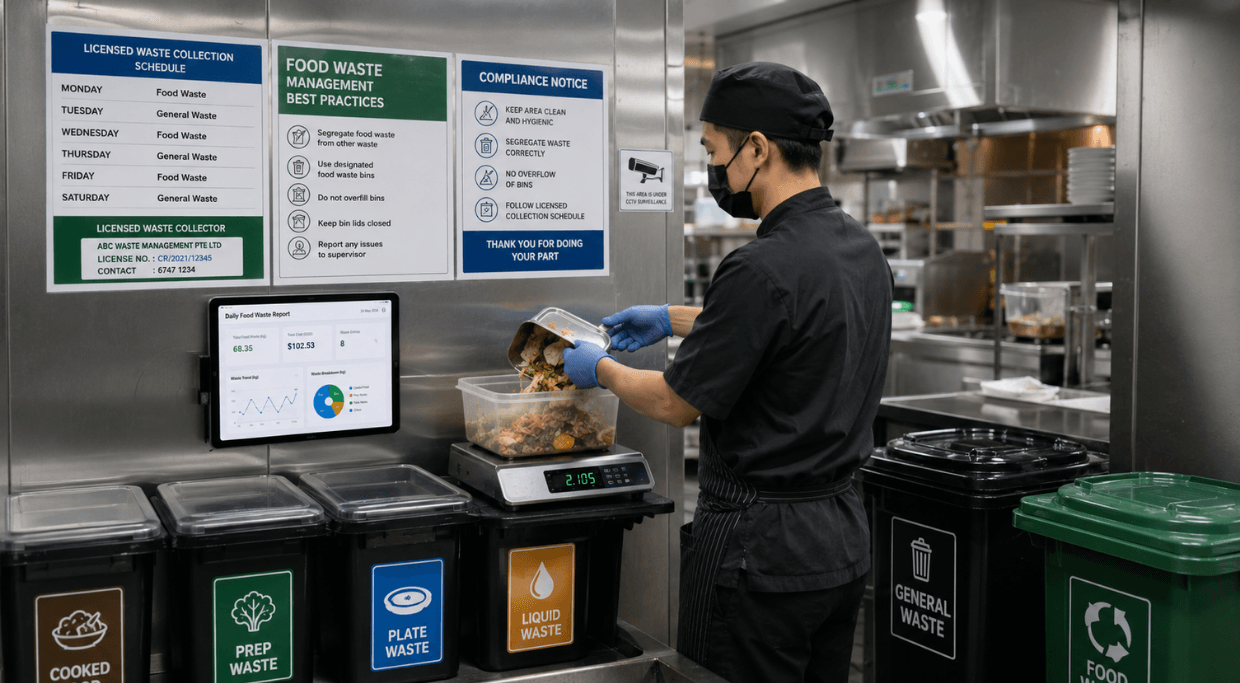
NEA’s Food Waste Management Framework for Commercial Premises
The Resource Sustainability Act requires large food service establishments to measure, report, and reduce food waste. Operators below the annual tonnage threshold must still segregate food waste from general refuse.
Which Operators Are Subject to Mandatory Food Waste Reporting
Large hotels, standalone restaurants, and central kitchen operations above the annual tonnage threshold must submit food waste data reports. Confirm whether your operation meets the threshold with the current NEA guidelines.
What Segregation, Storage, and Collection Requirements Apply
Food waste must be stored in covered, leak-proof containers and collected by licensed waste collectors. Using unlicensed collectors creates enforcement risk independent of how carefully waste is segregated.
How the Food Waste Reporting Obligation Affects Kitchen Operations
Operators subject to mandatory reporting must weigh food waste by category and track disposal methods daily. This requires a consistent system built into kitchen operations.
Pest Control Requirements and NEA’s Expectations
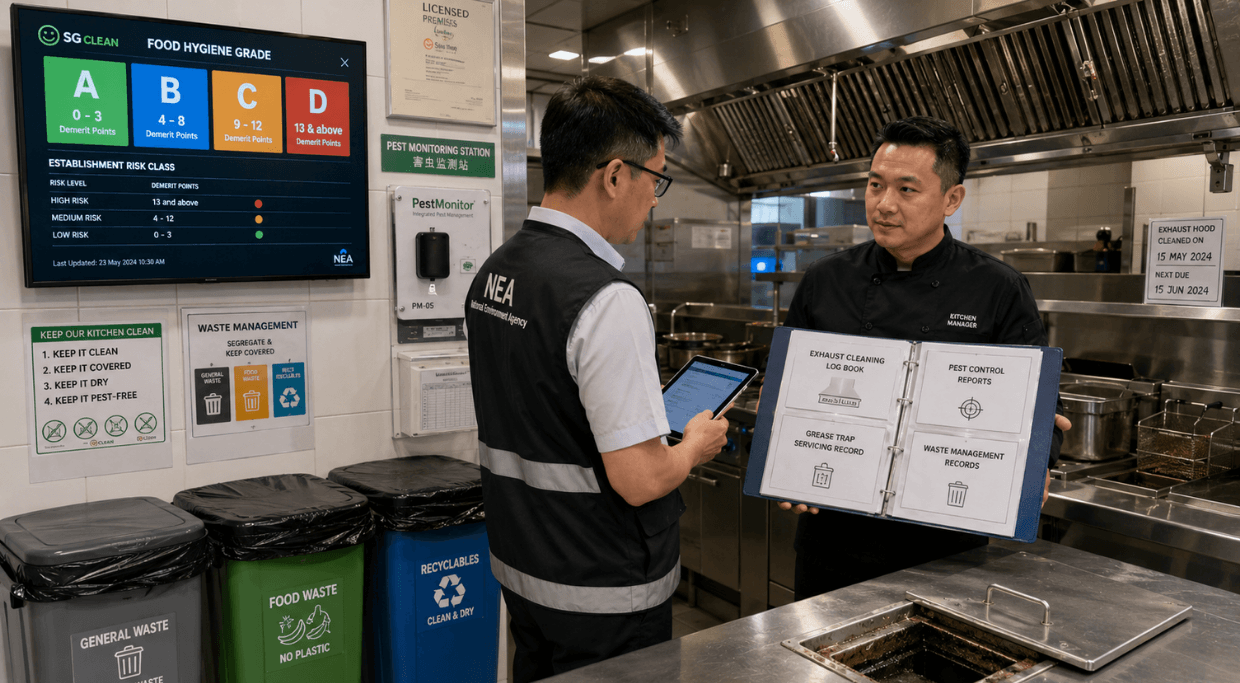
What NEA’s Pest Control Requirements Cover for Food Premises
NEA treats pest infestations as public nuisance issues under the EPHA. Rodents, cockroaches, and flies are the primary enforcement focus.
What a Qualified Pest Control Programme for a Commercial Kitchen Looks Like
A qualified programme requires a licensed pest management professional under a formal service contract covering inspection, treatment, and monitoring. Documented follow-up for findings is mandatory.
Documentation NEA Inspectors Look For During Pest Control Checks
The service record must include the contractor’s NEA licence number, service date, and treatment scope. Inspectors also look for physical evidence of ongoing monitoring: glue traps, bait stations, and exclusion measures.
NEA’s Inspection Regime and the Demerit Point System
How Frequently NEA Inspects Commercial Kitchens in Singapore
Inspection frequency depends on compliance history and complaint history. New establishments are inspected more frequently, and previous findings increase the frequency of follow-up visits.
What NEA Inspectors Check During a Commercial Kitchen Visit
Inspectors assess physical conditions first: grease accumulation, pest evidence, refuse bin conditions, and exhaust system state. They then review documentation. Both must be satisfactory.
The NEA Demerit Point System: What Each Level Means
Verify the specific thresholds below directly with NEA’s current published guidelines before acting on them.
0 to 11 Demerit Points: Standard Compliance Range
Points accumulate within the assessment period without triggering immediate suspension.
12 to 23 Demerit Points: First Suspension
Reaching 12 or more demerit points results in a two-week licence suspension. Corrective action must be demonstrated before reopening.
24 and Above: Second Suspension and Licence Revocation Risk
Reaching 24 points triggers a four-week suspension. Continued accumulation creates the risk of licence revocation.
How NEA’s Grading System Works and What It Means for Your Business
NEA’s A, B, C, and D grading reflects compliance history and is displayed publicly. A lower grade affects customer perception in ways that are not quickly reversed.
What Triggers an NEA Enforcement Action Beyond Routine Inspection
Neighbour complaints about exhaust odour or smoke trigger targeted inspections. Social media content showing non-compliant kitchen conditions has prompted enforcement. Building management complaints about FOG reach PUB and NEA simultaneously.
Common NEA Compliance Failures in Singapore Commercial Kitchens
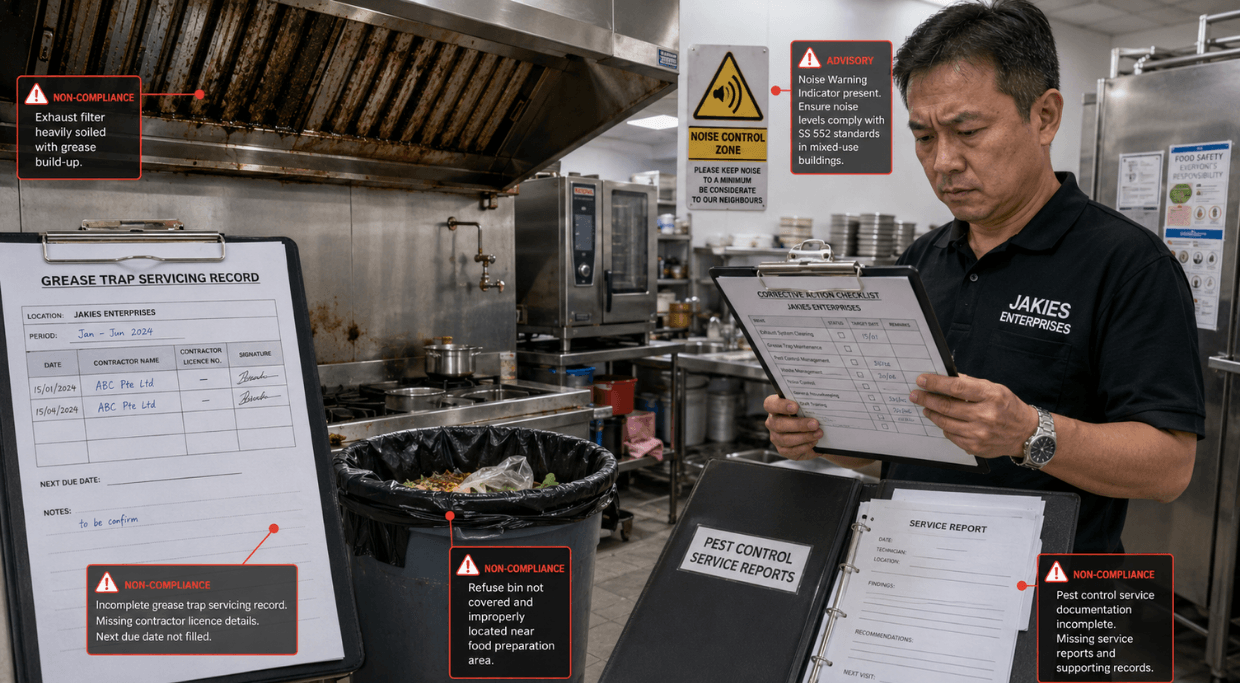
Exhaust Filter Cleaning Intervals Not Maintained to the Required Frequency
Busy kitchens postpone exhaust cleaning during peak periods. This is the most consistently cited finding. Building cleaning into the weekly calendar eliminates it.
Grease Trap Servicing Records That Are Incomplete or Absent
Missing contractor licence details, undated entries, or no record of grease volume removed all constitute incomplete records, even when the trap appears clean.
Pest Control Programmes Without Qualified Contractor Documentation
An operator who manages pests independently is non-compliant even when the kitchen appears immaculate. Documentation must be current, complete, and producible immediately.
Inadequate Refuse Bin Coverage and Waste Storage Conditions
Uncovered bins, bins stored adjacent to food preparation areas, and bins without regular collection are all immediate findings.
Noise Nuisance From Kitchen Operations in Mixed-Use Buildings
Establishments in buildings with residential units above or adjacent face noise nuisance exposure. Equipment suppliers such as Jackie’s Enterprise, which operates in Singapore’s commercial kitchen sector, factor the authority’s noise requirements into specifications for mixed-use building installations.
How to Prepare Your Commercial Kitchen for an NEA Inspection
Building a Compliance Calendar: What Must Be Done Monthly, Quarterly, and Annually
Monthly: refuse inspection, exhaust filter check, pest monitoring. Quarterly: grease trap servicing, exhaust cleaning, pest control review. Annually: food waste reporting, where applicable and full documentation audit.
The Documentation File an NEA Inspector Should Be Able to Review Immediately
Keep six record categories in one accessible file: exhaust cleaning logs, grease trap service records, pest control contracts and service history, food waste records where applicable, contractor licences, and previous enforcement notices. Every record must be retrievable within minutes.
What to Do if an NEA Inspector Identifies a Compliance Gap During a Visit
Acknowledge the finding, request written clarity on the requirement, and confirm the remediation timeline. Address the gap immediately rather than waiting for a follow-up visit.
Conclusion
NEA and SFA govern different aspects of the same commercial kitchen and compliance with one does not substitute for the other. The five core areas NEA regulates are exhaust system maintenance, grease trap management, food waste handling, pest control documentation, and refuse management. In every area, documentation is as important as physical condition. A compliance calendar that schedules all required maintenance at correct intervals, supported by a document file producible immediately during inspection, is the most practical approach to maintaining a compliant commercial kitchen in Singapore.