
Why NEA & SFA Compliance Matters for Central Kitchens
The Risks of Non-Compliance
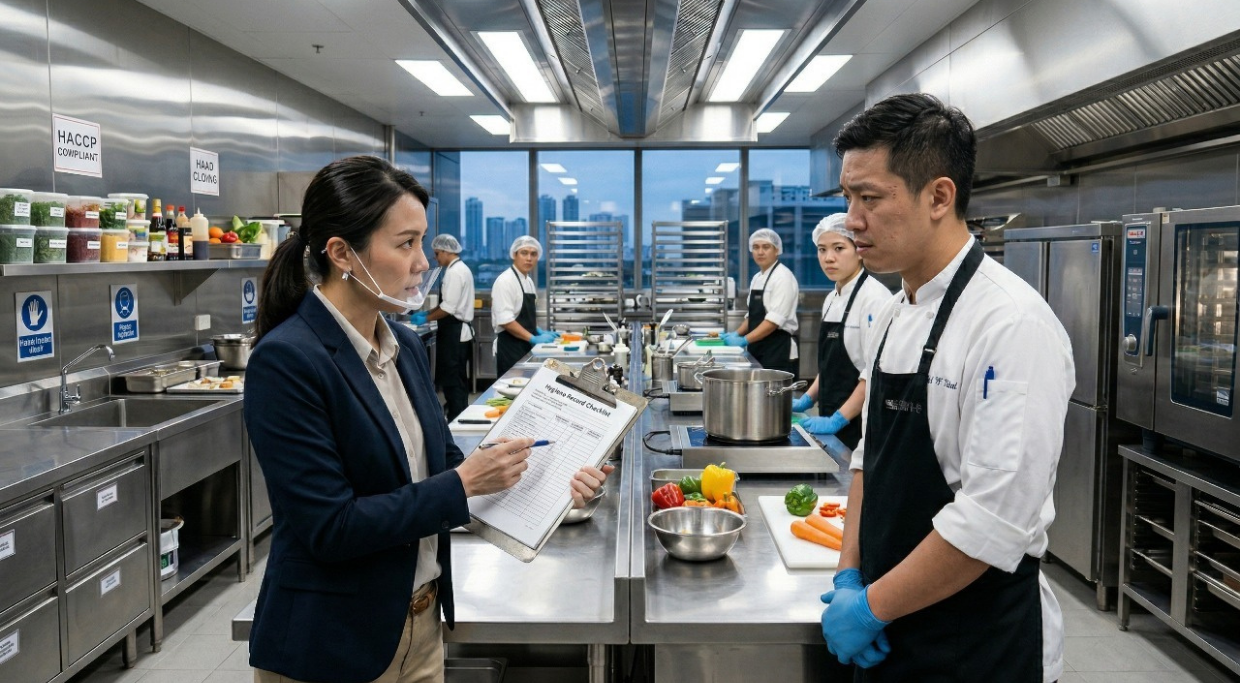
If you’re running a central kitchen without proper NEA and SFA licensing, you’re one inspection away from a “Stop Work” order. A single hygiene lapse costs you not just fines, but your entire operating license, and the contracts that depend on it.
Here’s what actually happens: Food suppliers stop delivering. Customers cancel standing agreements. Staff don’t know if they have jobs tomorrow. For schools, hospitals, or corporate clients, a licensing failure ends your contract immediately.
The math is simple: One compliance gap = lost revenue + lost reputation + months of remediation work.
Common Misconceptions About Licensing
You might think NEA and SFA licensing is one hurdle. It’s not. NEA (National Environment Agency) handles the physical environment, drains, pest control, layout. SFA (Singapore Food Agency) handles what happens inside, food temperatures, hygiene practices, and cross-contamination.
Many operators assume a retail food license covers central kitchens. It doesn’t. Retail licenses have different scope requirements. Central kitchens demand separate licensing because you operate at scale with different handling and documentation rules.
What this means for you: Applying for the wrong license type wastes 2–3 months and still leaves you non-compliant.
Real-World Example: The $200,000 Mistake
A central kitchen supplying meals to a major corporate client ran a tight ship, clean facilities, trained staff, good systems. But during the NEA inspection, inspectors asked for pest control documentation. The operator showed records, but NEA wanted something more: a systematic monitoring log with photographs and treatment dates. The kitchen didn’t have it.
NEA issued a 30-day closure notice. Revenue lost: $200,000. The kitchen had spent months preparing, invested in equipment, hired staff, then failed because of one overlooked requirement.
The operator later realized: the pest control contractor had done the work, but nobody had created the documentation system NEA expected to see. A simple protocol adjustment during the design phase would have prevented the entire crisis.
The lesson: Compliance failures aren’t usually about bad intentions. They’re about missing one detail that looks minor until the inspection arrives.
Understanding NEA & SFA Licensing Requirements
Introduction to NEA Licensing
You need NEA licensing for any kitchen producing food at scale, whether you’re supplying a school canteen, corporate catering program, or packaged meal delivery service.
NEA issues two types of licenses:
- Standard License: For kitchens preparing hot and cold foods, mixed items, or diverse product lines.
- Restricted License: For kitchens with limited scope (cold foods only, ready-to-eat items only, single product lines).
Your license type determines inspection frequency, documentation depth, and compliance complexity.
Key SFA Regulations for Food Establishments
You must maintain food safety at every stage. This means:
- Temperature Control: Store perishables at or below 4°C. Keep hot foods at 60°C or higher. Monitor and document temperatures daily.
- Cross-Contamination Prevention: Use separate preparation areas, utensils, and storage for raw and cooked foods.
- Allergen Handling: Label and segregate allergen-containing ingredients. Document allergen presence in finished products. Train all staff on allergen risks.
- Restricted Items: Certain foods (unpasteurized dairy, certain sprouts) are prohibited. SFA guidelines dictate which preparation methods work for specific ingredients.
You don’t just follow these rules, you document that you follow them. Daily temperature logs, cleaning checklists, supplier certifications, staff training records. This documentation becomes your defense during inspections.
Differences Between NEA and SFA Oversight

Think of it this way:
- NEA: The “shell” (Facility layout, drains, trash management, pest barriers, ventilation).
- SFA: The “inside” (Food temperatures, hygiene practices, staff behavior, contamination prevention).
You need both licenses because one without the other leaves you exposed. A perfectly designed kitchen (NEA-approved) with poor food handling practices (SFA violation) will fail inspection. The reverse is equally problematic.
Eligibility and Prerequisites
Your premises must meet strict requirements:
- Separate zones for raw and cooked food preparation.
- Adequate handwashing stations (separate from equipment and food washing).
- Food-grade stainless steel equipment (no makeshift or repurposed items).
- Sufficient ventilation to manage heat and humidity.
- Segregated waste disposal system (general, organic, recyclables).
Your staff must be trained and certified:
- All personnel need basic food safety training.
- At least one senior staff member must complete a certified Food Hygiene Management course.
- Staff must follow hygiene protocols: no jewelry, short nails, proper uniform, regular medical check-ups.
You must maintain documentation:
- Inventory logs with supplier details.
- Daily temperature records for all refrigeration and cooking.
- Cleaning schedules with completion signatures.
- Supplier certifications and food traceability records.
- Incident and corrective action logs.
Digital systems are increasingly expected. Manual logs are acceptable but harder to defend during inspections.
Practical Guidance for Meeting Requirements
Step-by-Step NEA Licensing Process
Step 1: Pre-Application Consultation
Contact NEA through the Singapore GoBusiness portal. This is where you submit all applications and track approvals. You’ll need your CorpPass credentials to log in. During pre-consultation, you outline your kitchen’s operations and design plans. NEA provides feedback on approval pathways before you invest in construction or equipment.
Step 2: Formal Application Submission
You submit your formal application through GoBusiness with:
- Completed NEA forms
- Architectural floor plans with dimensions and zoning
- Equipment specifications (capacity, certifications, materials)
- Initial staff training documentation
Processing takes 4–6 weeks, though timelines vary based on application completeness. Incomplete applications (missing supplier certifications, vague design details) add 2–4 weeks.
Step 3: Design Review & Inspection Preparation
NEA reviews your plans and identifies required changes. Common feedback points: spatial zoning, equipment placement, drainage design, pest control barriers. You revise and resubmit. Then you complete installations, establish staff training, and create SOPs.
Step 4: Initial Inspection
An NEA officer conducts a full facility walk-through, checking:
- Layout and workflow (does it prevent cross-contamination?).
- Equipment installation and certification.
- Pest control systems and documentation.
- Temperature monitoring systems.
- Staff competency records.
- Initial temperature and cleaning logs.
Step 5: Approval & Probationary Period
You receive a provisional license with a 6-month probationary period. NEA conducts monthly compliance audits during this time. After 6 months, you move to standard annual renewal with routine audits.
Phase | Timeline | Deliverables | Common Pitfalls |
Pre-application (GoBusiness) | 1–2 weeks | Concept plans, operational outline via portal | Vague operational descriptions, missing details on product lines |
Application submission (GoBusiness + CorpPass) | 1 week | Forms, floor plans, equipment list, staff credentials | Missing supplier certifications, incomplete design specifications |
Design review & feedback | 2–3 weeks | Revised plans incorporating NEA feedback | Misunderstanding spatial or zoning requirements, drainage issues |
Inspection prep | 2–4 weeks | Final installations, staff training, SOPs, initial logs | Temperature logs not yet established, staff training incomplete |
Initial inspection | 1 day | Facility walk-through, document verification | Poor record organization, gaps in pest control evidence |
Probationary approval | 6 months | Monthly audits, ongoing compliance | Inconsistent temperature logging, cleaning schedule lapses |
Standard vs Restricted License: Which Do You Need?
Aspect | Standard License | Restricted License |
Food Types | Hot, cold, mixed, diverse products | Cold foods only OR ready-to-eat items only |
Preparation Methods | Full range (cooking, chilling, reheating) | Limited to assembly or reheating |
Scope | Multiple product lines, complex operations | Single product line or simple operations |
Inspection Frequency | Quarterly or semi-annual | Annual or as-needed |
Documentation | Extensive (temperature logs, allergen tracking, waste records) | Simplified but still required |
Equipment Requirements | Full commercial kitchen setup | May allow simplified setup |
When to Choose | School meals, corporate catering, meal delivery services | Pre-made meal assembly, ready-to-eat packaging, specialized single-item operations |
Designing a Compliant Central Kitchen
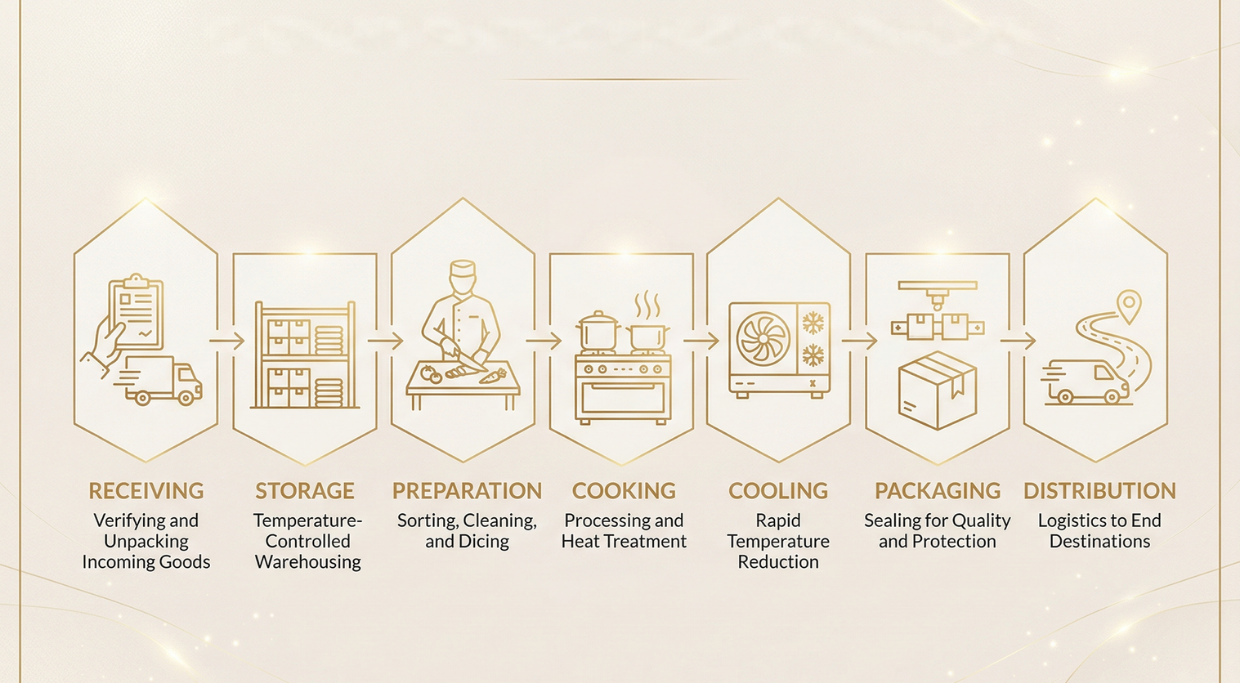
Workflow efficiency prevents contamination and makes compliance automatic. Your layout should follow a linear flow:
Receiving → Storage → Preparation → Cooking → Cooling → Packaging → Distribution
This prevents backtracking, cross-contamination, and temperature breaks.
Material selection matters:
- Surfaces: Stainless steel for countertops, tables, shelving (non-porous, easily sanitized).
- Flooring: Epoxy with adequate slope for drainage (prevents water pooling and pest harborage).
- Handwashing: Separate stations with foot pedals and automatic soap dispensers.
Pest control combines physical barriers (door sweeps, window screens, sealed gaps) with documented monitoring through a licensed pest control contractor. You maintain a log with inspection dates, findings, and treatments.
Maintaining Continuous Compliance
You maintain compliance through three actions:
- Weekly Self-Inspections
Use a checklist covering: temperature logs (complete and accurate?), cleaning records (signed off?), storage conditions (raw separate from cooked?), staff hygiene (uniforms clean, jewelry removed?). Document findings and corrective actions.
- Employee Hygiene Enforcement
Training isn’t enough, you enforce it daily. Conduct monthly refresher briefings. Inspect uniforms and personal hygiene during shifts. Hold staff accountable for SOP violations. Document all incidents and corrective actions.
- Root-Cause Analysis for Violations
Minor issues (disorganized storage) you fix within days. Major issues (temperature control failures) require investigation. Why did the refrigerator fail? Was it maintenance, installation, or staff error? Fix the root cause, not just the symptom. Document everything.
Common Pitfalls and Lessons Learned
Incomplete Applications: NEA expects granular facility descriptions. Provide floor plans with dimensions, equipment specs with capacity and certifications, staff training records with completion dates and trainer credentials. Vague submissions add 4+ weeks to processing.
Misinterpreting Storage Rules: The assumption that “cooled items can be stored together” ignores specific rules around raw vs cooked separation, allergen isolation, and stack heights (which affect air circulation). Read SFA guidelines carefully, don’t assume.
Overlooking Staff Training: A perfectly designed kitchen with untrained staff fails SFA inspections repeatedly. Certified training and annual refreshers are non-negotiable. Make it a line item in your budget.
Poor Documentation: You can have perfect practices but fail inspection if you don’t document them. Temperature logs, cleaning checklists, incident reports, create systems before you open, not after.
NEA & SFA Updates and Policy Changes
Regulatory guidance evolves. Subscribe to NEA and SFA email alerts through their official websites. Both agencies publish annual compliance updates and revised guidelines.
When updates occur, assess their impact on your operations. Some changes require equipment upgrades; others just need protocol revisions. Build a 3–6 month implementation window into your operational planning to accommodate regulatory shifts without service disruption.
Taking Steps Toward NEA & SFA Compliance
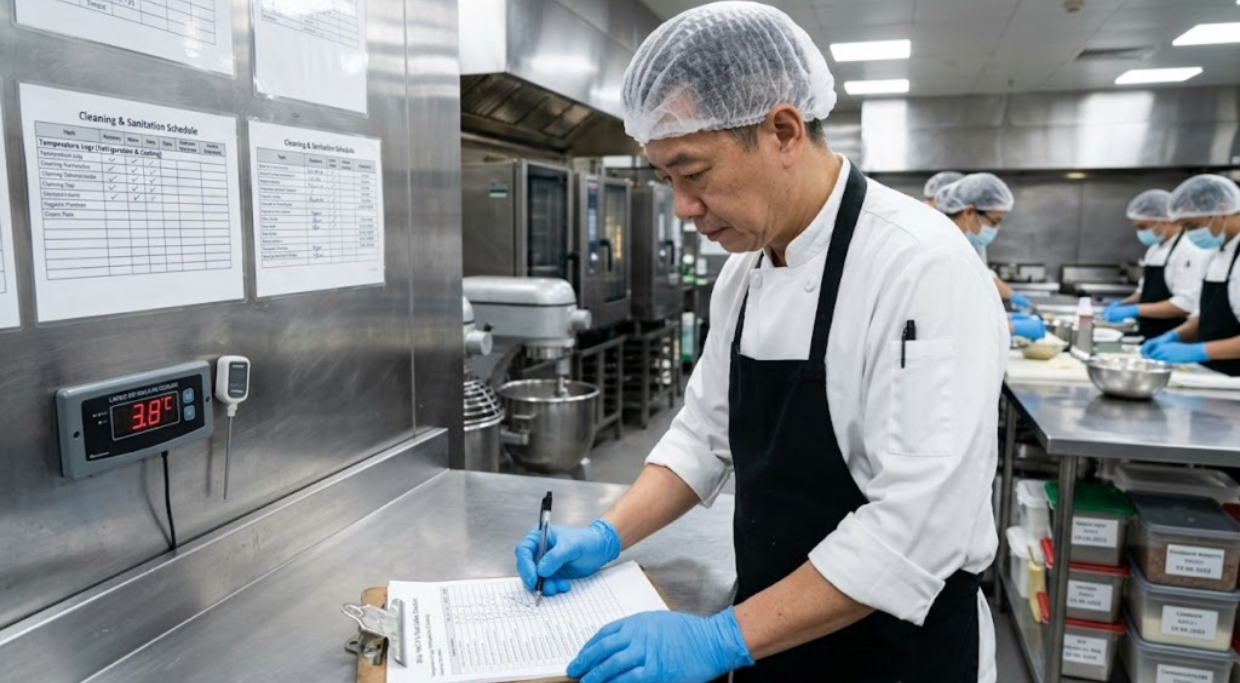
Checklist Before Applying for NEA Licensing
Premises Readiness:
- [ ] Floor plans finalized with separate zones for raw and cooked food
- [ ] Handwashing stations installed (separate from equipment and food washing)
- [ ] Ventilation system operational
- [ ] Pest barriers in place (sealed gaps, door sweeps, screens)
Equipment & Systems:
- [ ] All food-contact equipment approved and installed
- [ ] Temperature monitoring devices calibrated and tested
- [ ] Waste segregation system operational
- [ ] Cleaning supplies organized and labeled
Documentation & Records:
- [ ] Staff training certificates on file
- [ ] Supplier certifications collected
- [ ] SOP documentation written and reviewed
- [ ] Initial temperature and cleaning logs prepared
Staff Readiness:
- [ ] All personnel completed basic food safety training
- [ ] Designated manager holds Food Hygiene Management certification
- [ ] Team understands daily protocols and documentation requirements
How to Use GoBusiness Portal for NEA Applications
You submit all NEA applications through the Singapore GoBusiness portal. Here’s the 3-step process:
Step 1: Register with CorpPass
Log in with your CorpPass credentials (your Singapore business registration number and digital identity). If you don’t have CorpPass, apply for it first through the GoBusiness homepage, it takes 2–3 business days.
Step 2: Access NEA Licensing Forms
Search “Food Establishment License” in the GoBusiness portal. Select the appropriate application (Standard or Restricted). Download the forms and complete them offline, or fill them in directly through the portal.
Step 3: Submit & Track
Attach supporting documents (floor plans, equipment certifications, staff training records, photos of facility). Submit through GoBusiness. You receive a transaction reference number and can track application status in real-time through your dashboard.
GoBusiness sends you email updates at each approval stage. This is your official communication channel, check it daily during processing.
Resources and References
Official guidance is available through:
- NEA Licensing Portal (GoBusiness): www.gobusiness.gov.sg , Submit applications, access forms, view guidance documents.
- SFA Food Safety Guidelines: www.sfa.gov.sg , Download hygiene standards, allergen handling protocols, temperature requirements.
- Singapore Food Manufacturers’ Association: Industry networking, peer advice, training courses tailored to central kitchens.
Expert Advice
Consultancy support helps if you have complex facility designs or multiple product lines. A food safety consultant experienced with central kitchens reviews your plans before submission and identifies likely inspection issues. Cost: typically $2,000–$5,000. Value: avoiding costly design revisions and inspection delays.
Learning from experienced operators is equally valuable. Many successful central kitchens maintain relationships with compliance authorities and share best practices. These peer networks reveal emerging compliance trends early.
Companies like Jackie’s Enterprise have successfully navigated NEA licensing by establishing strict workflow protocols and consistent documentation systems during the design phase. This demonstrates that compliance is achievable through disciplined operational planning and staff commitment.
Conclusion
NEA and SFA licensing for Singapore central kitchens requires understanding two distinct regulatory systems, designing facilities that support both environmental and food safety standards, and maintaining rigorous operational discipline.
Non-compliance carries severe consequences: lost revenue, lost contracts, lost reputation. But the process is navigable with proper planning.
The critical insight is this: Compliance begins during design, not after opening. A kitchen designed around regulatory requirements from the start avoids costly retrofits and inspection failures.
Your next action is straightforward: Register for CorpPass if you haven’t already. Log into GoBusiness. Schedule a pre-application consultation with NEA. Confirm your license type (Standard or Restricted). Gather your facility plans and staff credentials.
From there, the pathway to approval becomes clear, and your business gains the legitimacy and food safety foundation it needs to operate sustainably.