

The Shelf-Life Challenge Facing Modern Central Kitchens
Food waste is one of the most significant hidden costs in central kitchen operations. When components spoil, the impact is immediate: lost ingredients, disposal fees, and wasted labor. For kitchens serving multiple locations, even a 5% spoilage rate translates to thousands of dollars lost monthly. Traditional refrigeration extends shelf life to days, but competitive central kitchens need to store prepared food safely for weeks. Freezing damages texture. Chemical preservatives raise regulatory concerns. Vacuum packaging solves this gap.
What Vacuum Packaging Is and How It Works
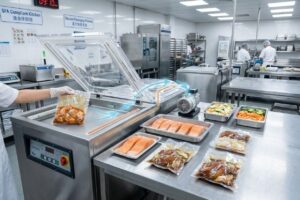
Vacuum packaging works by removing oxygen, most bacteria and mold require oxygen to grow. When air is removed from a sealed package, microbial growth slows dramatically. Oxidation (which causes rancidity and color fade) also requires oxygen, so removing it preserves nutritional quality, appearance, and taste far longer than refrigeration alone.
Shelf-life extension depends on food type and temperature: Fresh meats last 2–3 weeks instead of 5–7 days. Prepared sauces last 3–4 weeks instead of 1 week. Marinated proteins maintain consistent flavor because vacuum accelerates marinade penetration while protecting against oxidation.
Best candidates for vacuum packaging: Fresh meats, poultry, and seafood; prepared meals, sauces, and marinades; vegetables and soft produce; and dry goods like nuts and spices.
What Is a Commercial Vacuum Packing Machine?
Core Components of a Vacuum Packaging Machine
Every commercial vacuum packing machine contains the same basic elements. The vacuum pump (motor-driven component) removes air from the package. A sealing bar heats and seals the packaging material after air is removed. The chamber system creates an enclosed space where this happens. And a control panel allows operators to adjust vacuum strength, sealing temperature, and cycle duration.
The Basic Vacuum Sealing Process Step by Step
Place food in the appropriate packaging material. Place the sealed end of the package into the machine’s chamber. Close the lid or activate the machine. The vacuum pump removes air from the chamber (and the package inside it). Once air is removed to the programmed level, the sealing bar activates, heating and melting the package material to create an airtight seal. The chamber releases, and you remove the sealed package. The entire cycle typically takes 10–30 seconds per package.
Types of Commercial Vacuum Packing Machines
- Chamber Vacuum Packaging Machines: Vacuum both package and chamber together. Ideal for liquids, sauces, and wet foods. Best suited for central kitchens.
- External Vacuum Sealers: Compact machines that vacuum only the package. Work well for dry goods and solid foods but cannot handle wet foods well. Suit smaller operations.
- Double-Chamber Industrial Machines: Two chambers operating simultaneously, doubling throughput. Support higher-volume operations.
- Belt-Type Industrial Vacuum Machines: Continuous conveyor-like systems for large-scale food manufacturing.
| Machine Type | Best For | Throughput | Typical SFA Use Case | Key Limitation |
| Chamber Vacuum | Central kitchens, sauces, wet foods, marinades | 40–80 packages/hour | Cook-chill systems, chilled ready-to-eat meals | Higher cost, larger footprint |
| External Sealer | Dry goods, smaller operations, whole proteins | 30–60 packages/hour | Non-potentially hazardous foods, dry storage | Cannot handle liquids well |
| Double-Chamber | Growing central kitchens, batch production | 80–120 packages/hour | High-volume cook-chill operations | Moderate space requirement |
| Belt-Type Industrial | Manufacturing, 1000+ packages/day | 200+ packages/hour | Export/manufacturing compliance, food processing facilities | Very high cost, specialized need |
Why Central Kitchens Are Adopting Vacuum Packaging
Vacuum packaging extends shelf life through physics, not preservatives, enabling “clean label” products. Extended shelf life reduces spoilage, improves batch production efficiency, and maintains consistency across multi-location operations. Prepared components stored safely for 2–3 weeks instead of days unlock economies of scale central kitchens depend on.
Operational Benefits of Vacuum Sealers for Singapore Food Businesses
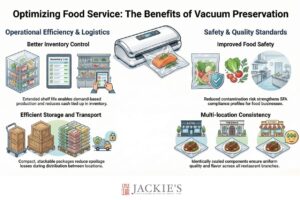
- Better inventory control: Extended shelf life enables demand-based production planning and reduces cash tied up in inventory.
- Improved food safety: Reduced surface exposure and contamination risk strengthens SFA compliance profiles.
- Efficient storage and transport: Compact, stackable packages reduce spoilage losses during distribution.
- Multi-location consistency: Identically sealed components ensure quality and flavor consistency across restaurant locations.
Common Applications of Vacuum Packaging in Central Kitchens
- Sous Vide Cooking Preparation: Vacuum sealing is required for sous vide, cooking food in sealed bags in controlled-temperature water. ⚠ Food Safety Note: If your central kitchen uses vacuum packing for sous vide applications, ensure you understand and comply with all relevant SFA food safety requirements. Check with your food safety advisor or SFA contact to confirm any permits, documentation, or staff certifications needed for your specific operation.
- Pre-Portioned Ingredients: Marinated proteins, prepped vegetables, and sauces vacuum-sealed for satellite locations.
- Ready-to-Heat Meal Packaging: Meal-prep services and catering operations depend on extended shelf life for customer reheat-at-home models.
- Bulk Food Storage: Catering companies prepare components days in advance using vacuum packaging to preserve quality through service day.
Key Factors When Choosing a Commercial Vacuum Packing Machine
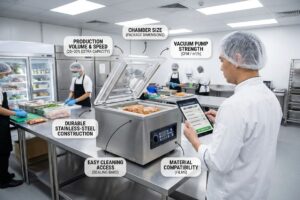
- Production Volume and Speed: Choose a machine with 20–30% excess capacity over your peak daily volume to avoid bottlenecks.
- Chamber Size: Ensure the machine accommodates your typical package dimensions with room to spare.
- Vacuum Pump Strength: Measured in cubic feet per minute (CFM) or cubic meters per hour (m³/h)—1 CFM ≈ 1.7 m³/h. Higher strength is essential for wet foods and sauces.
- Durability: Stainless steel construction and industrial-grade components prevent costly failures.
- Ease of Cleaning: Look for designs allowing easy access to sealing bars and internal surfaces for sanitation.
- Material Compatibility: Confirm the machine works reliably with your specific packaging films and bags.
Common Mistakes Businesses Make When Adopting Vacuum Packaging
- Choosing machines too small for production needs: Underestimating packaging volume forces expensive upgrades within weeks. Choose a machine with 20–30% excess capacity.
- Ignoring packaging material quality: Cheap bags fail, ruining products and frustrating staff. Better bags cost marginally more and prevent failures.
- Overlooking staff training: Untrained operators create weak seals and waste materials. Clear training and standard operating procedures are critical.
Integrating Vacuum Packaging Into Central Kitchen Workflow
Position the vacuum machine in your workflow after preparation but before storage, with a cooling area for sealed packages. Vacuum-pack food when fully cooled but before it begins to dry out.
Maintaining Food Safety Compliance: Vacuum-packed chilled foods create an anaerobic environment. Proper temperature control is critical to food safety. Your central kitchen should maintain documented cooling protocols and temperature monitoring before and after packaging. Consult current SFA food safety guidelines to confirm exact storage temperature requirements for your specific products, as these may vary by food type. Document your cooling times and temperature controls to demonstrate compliance during SFA inspections.
Commercial kitchen equipment providers such as jackie’s enterprises assist food businesses in selecting vacuum packaging systems matched to their production scale and kitchen layout.
Ongoing Maintenance and Operational Costs
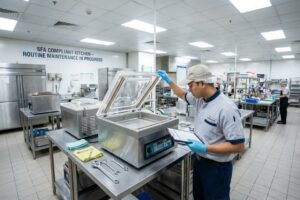
Beyond initial investment, commercial vacuum machines require regular maintenance. Most commercial vacuum pumps need regular oil changes (check your manufacturer’s specifications for frequency). Sealing bars accumulate residue and require periodic maintenance or replacement depending on usage intensity. Vacuum pump filters should be checked regularly and replaced when clogged. Plan to budget for ongoing maintenance costs when calculating your return on investment—ask your equipment supplier for specific maintenance schedules and estimated annual costs for your machine model.
When Vacuum Packaging May Not Be the Best Solution
Some foods require specific gas mixtures (nitrogen, CO2)—these need MAP machines, not vacuum packaging. Highly delicate items may deteriorate too quickly for vacuum packaging to meaningfully help. Operations packaging fewer than 50 units per week may find outsourcing to a co-packing facility more cost-effective.
Practical Checklist Before Investing in a Vacuum Packing System
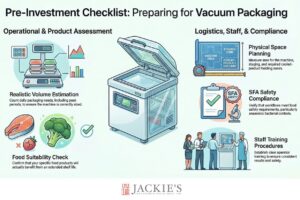
- Estimate daily packaging volume: Count realistically, including peak periods, to right-size the machine.
- Identify foods suitable for vacuum packaging: Confirm your products benefit from extended shelf life.
- Evaluate kitchen space: Measure space for the machine, staging areas, and cooled-product holding.
- Plan staff training: Clear procedures and operator training are critical for consistent results.
- Verify SFA compliance: Ensure your workflow meets food safety requirements, especially anaerobic bacterial controls.
Ready to Implement Vacuum Packaging?
For guidance on selecting a vacuum sealer suited to your production scale and food safety requirements, Jackie’s Enterprises offers free equipment consultations.
Conclusion
Vacuum packaging has become a critical technology for modern central kitchens seeking to extend shelf life, reduce food waste, and maintain consistent food quality across operations. By understanding how commercial vacuum packing machines work and how they integrate into kitchen workflows, food businesses can make more informed decisions about adopting vacuum packaging as part of their production strategy. The right machine, matched to your volume and food types, transforms how efficiently your central kitchen operates—reducing waste, improving margins, and supporting the scale at which modern food businesses compete.